
Introduction
Addis Ababa is usually introduced as Ethiopia’s capital, the seat of the African Union, and one of Africa’s most important diplomatic cities. The same site is also Finfinnee, an Oromo place whose name, memory, and territorial meaning predate the imperial capital. This article argues that Addis Ababa’s national, federal, metropolitan, and diplomatic universality has been represented and institutionalized partly through practices that abstract Oromo territorial grounding into higher-order state and continental space.
The article approaches this question through critical political geography. Finfinnee/Addis Ababa brings together five territorial and institutional orders that do not fully align: Oromo territorial grounding, late-nineteenth-century imperial incorporation, constitutionally protected municipal self-government, federal-capital status together with Oromia’s constitutionally recognized special-interest relationship, and continental diplomatic elevation through the Organization of African Unity (OAU) and the African Union (AU). Article 49 makes Addis Ababa the capital city of the Federal State, guarantees its residents a full measure of self-government, makes the city administration responsible to the Federal Government, and provides residents with representation in the House of Peoples’ Representatives. It also requires the special interest of the State of Oromia—including interests concerning social services, natural resources, similar matters, and joint administrative matters arising from the city’s location within Oromia—to be respected. The particulars of residents’ self-government and Oromia’s special interest are to be determined by law (FDRE 1995, art. 49(1)–(5)). The provision therefore recognizes both residents’ self-government and Oromia’s special-interest relationship but does not itself settle how those interests are to be institutionally reconciled.[1] Geleta (2014) characterizes the resulting implementation deficit as an undelivered constitutional promise, while Fessha (2020) treats the relationship principally as a problem of intergovernmental cooperation. Read together, the constitutional design and its contested implementation make the article’s institutional and territorial misalignment legally visible.
The central question is how a capital can become publicly authorized as national, federal, metropolitan, and diplomatic while its constitutive territorial relationship remains weakly recognized and carries little consequential institutional force.
Consequential authority means a legally or institutionally recognized capacity to shape, authorize, contest, review, or obtain a remedy against decisions that reorganize the territorial relationship. It is domain-specific and is not used as a synonym for full sovereignty or self-determination.
In this article, capital-city sovereignty is an analytical term for the concentration and public performance of state, municipal, symbolic, and diplomatic authority through a capital, including its roles in organizing jurisdiction, representing national sovereignty, defining public history, and performing national or diplomatic universality. The term synthesizes scholarship on federal-capital governance, contested capital-city authority, and the diplomatic centrality of Finfinnee/Addis Ababa (Fessha 2020; Gemechu 2024; Wubneh 2013); it does not imply that the municipality possesses sovereignty independently of the state and is not synonymous with municipal self-government or autonomy. Within this broader field of capital-city authority, the article develops the imperial-capital enclave to explain a more specific formation: one in which a capital founded through territorial incorporation remains materially dependent on the surrounding territory while its governing identity and public authority become jurisdictionally and symbolically insulated from that constitutive territorial relationship. The capital therefore becomes a privileged site where state, municipal, symbolic, and diplomatic forms of authority are assembled and where the territorial terms of belonging are made publicly legible.
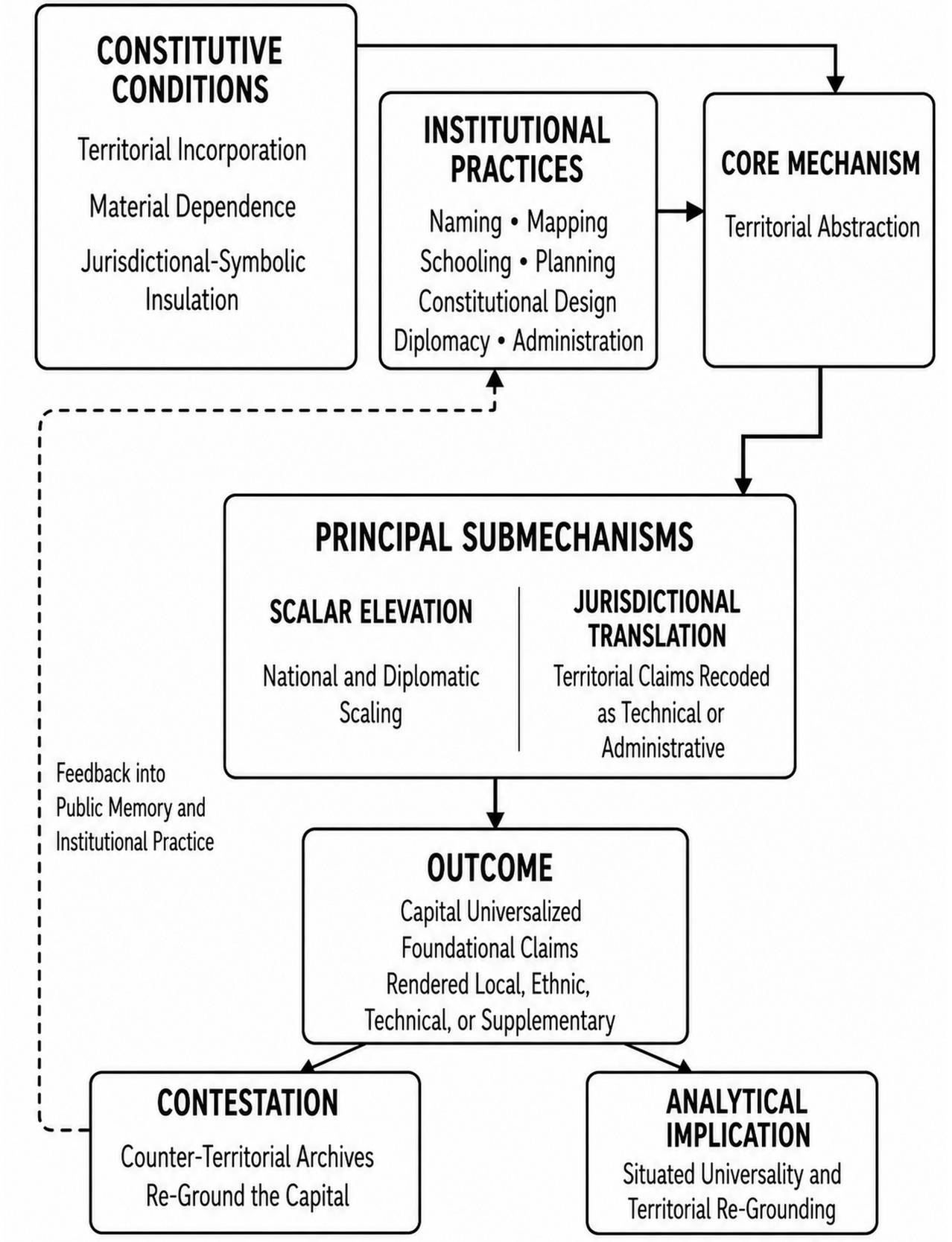
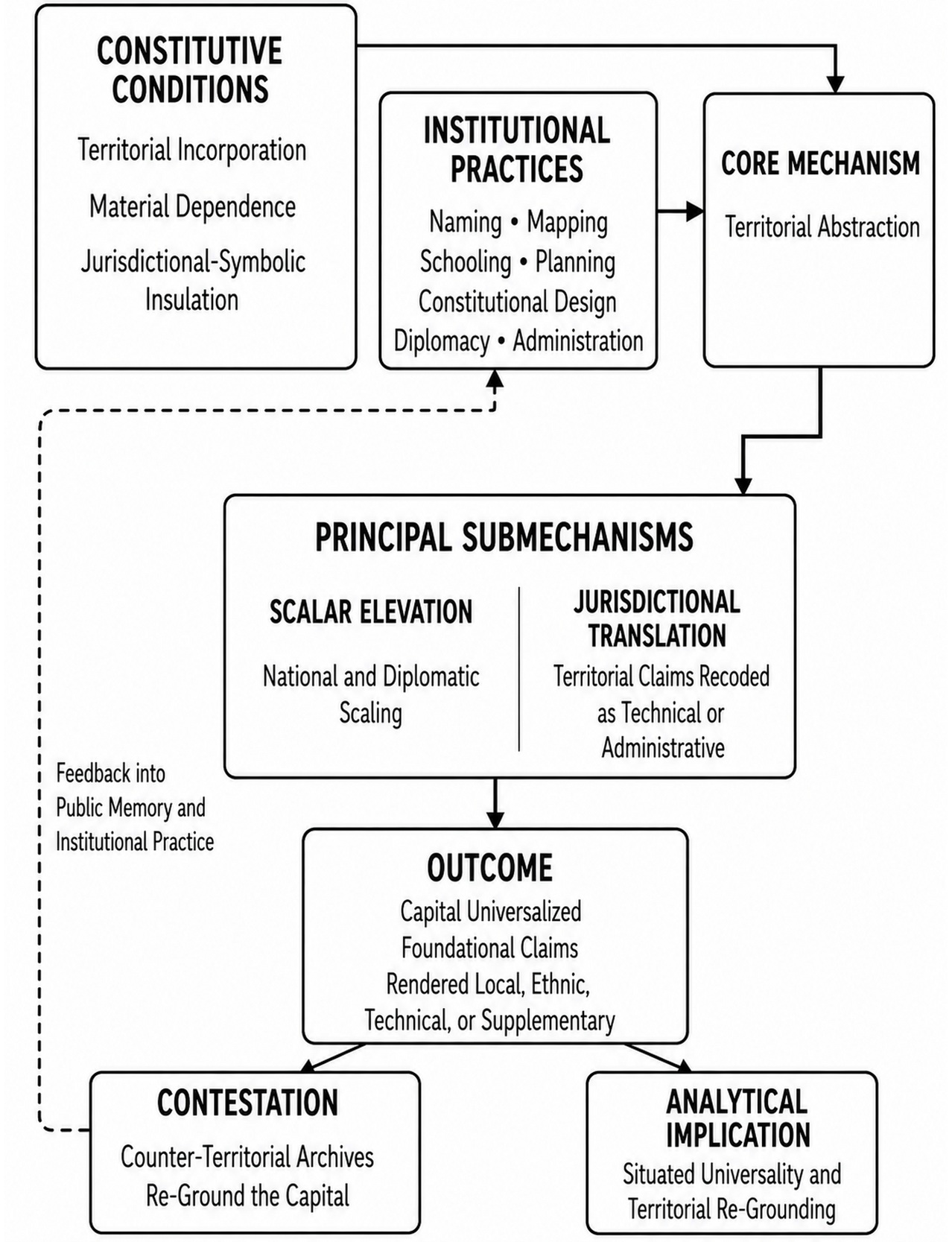
The analysis identifies an analytical sequence rather than a linear or irreversible historical progression. Imperial incorporation, capital siting, and unresolved territorial authority provide the historical antecedents. Naming, mapping, schooling, planning, constitutional design, diplomacy, and metropolitan administration are the institutional practices. Territorial abstraction separates the capital’s public authority from its constitutive territorial relationship. Scalar elevation and jurisdictional translation reproduce that separation, and the resulting order renders the city national, federal, metropolitan, and diplomatic while recoding Oromo territorial claims as local, ethnic, administrative, or disruptive. Counter-territorial archives contest the outcome, and territorial re-grounding names the resulting analytical implication.
Urban and metropolitan expansion are distinguished here. Urban expansion refers to the capital’s actual outward physical growth and associated land conversion; metropolitan expansion refers to the construction or extension of a cross-boundary planning, governance, and infrastructural scale linking the city with surrounding Oromia. The two may overlap, but metropolitan planning need not correspond to coherent or formally coordinated physical growth. Urban expansion can be informal, incremental, or weakly coordinated. Where expropriation, master planning, or redevelopment defines a cross-boundary scale, authorizes land conversion, or allocates its burdens, however, these processes also operate as exercises of territorial authority. The 2014–2016 Integrated Master Plan controversy illustrates the mechanism: metropolitan expansion was narrated through infrastructure, coordination, growth management, and modernization, while Oromo resistance reframed the issue as one of territorial authority, constitutional recognition, and political accountability (Abate 2019; Human Rights Watch 2016; G. O. G. O. Wayessa 2019). Oromo resistance also articulated a claim to development without dispossession, forced eviction, or the marginalization of farmers and communities affected by urban expansion.
The article makes four contributions. First, it reframes Finfinnee/Addis Ababa as a problem of territorial recognition, consequential authority, and land conflict rather than a naming dispute or urban-expansion controversy alone. Second, it specifies the imperial-capital enclave as a form of jurisdictional and symbolic insulation, not merely a contested capital on incorporated land. Third, it shows how state territorialization, diplomatic scalar elevation, federal-capital ambiguity, and counter-territorial archives interact rather than operating as separate domains. Fourth, it uses mechanism-probing comparisons to distinguish the Finfinnee/Addis Ababa case from colonial, settler-colonial, contested-sovereignty, and purpose-built federal capitals.
The argument is not merely that Oromo actors seek symbolic recognition of an alternative name. Finfinnee is historically constituted within Oromo territory, remains legally and constitutionally linked to Oromia, and continues to be implicated in conflicts over land, displacement, jurisdiction, and political authority. Territorial recognition therefore concerns the institutional consequences of that relationship, not symbolic acknowledgment alone.
A note on naming: this article uses Finfinnee/Addis Ababa when emphasizing Oromo territorial grounding and Addis Ababa/Finfinnee when discussing state, diplomatic, planning, or institutional nomenclature. Finfinnee is the preferred Oromo spelling; Finfine and Finfinne are preserved where they appear in cited sources, titles, legal or activist discourse, and older English-language materials. The Oromo referred to themselves as Oromo and to their language as Afaan Oromo, rendered by Huntingford as “afan oromo” (Huntingford 1955). The variation shows how the same site is differently named and authorized across Oromo memory, Ethiopian state formation, federal law, and diplomatic discourse (Abate 2019; Chimdi 2004; Debelo and Soboka 2023; Geleta 2014; Osman 2023).
Historical orientation
Finfinnee refers to an Oromo place and landscape whose territorial meaning predates the imperial capital. Historical scholarship identifies the area as Oromo land incorporated through late-nineteenth-century imperial expansion and reorganized as Ethiopia’s capital (Benti 2002; Gulema 2012, 2013; Hassen 1990; Zewde 2001). The founding of Addis Ababa/Finfinnee in the 1880s converted this territorial and cultural geography into an imperial and national center through military settlement, land allocation, safar formation (camp- and quarter-based settlement), and the symbolic remaking of place (Benti 2002; Fayisa 2020; Gulema 2013; Tola 2023).
Hassen (1990) rejects accounts of Oromo communities as late external intruders. Harris (1844), Cerulli (1922), and Huntingford (1955) are used as external historical and colonial-era records of observation, classification, and naming, not as neutral descriptions. The 2004 submission to the United Nations Working Group on Indigenous Populations is likewise treated as an Oromo advocacy document rather than a binding United Nations determination (Chimdi 2004).
Addis Ababa/Finfinnee was not only consolidated as Ethiopia’s political and administrative center; it was also imagined and practiced as a “city as nation,” a privileged site through which modern Ethiopian statehood, national identity, and modernization were represented (Gulema 2012, 2013). Its multiethnic and migrant character expanded, but dominant accounts of civic identity remained closely tied to state-centered narratives of modernity, imperial achievement, and national unity. The creation of the OAU in 1963 transformed the city’s scale. Addis Ababa/Finfinnee became an institutional address for Pan-African diplomacy and later the African Union, acquiring continental legitimacy beyond the Ethiopian state (African Union Commission 2015; Benti 2007; Gebrekidan 2012; Gulema 2013; Organization of African Unity 1963; Pellerin and Ashenafi 2023; United Nations 1963; van Gameren and Tola 2017; Wubneh 2013; Zewde 2001).
Under the Derg, Addis Ababa/Finfinnee remained a central site of socialist state-making while the institutional basis of urban land and public space changed substantially. The 1975 nationalization of urban land and extra houses shifted urban property toward state ownership, while the regime’s remaking of Meskel Square for mass political and military spectacle tied the capital’s-built environment to centralized revolutionary authority (Provisional Military Administrative Council 1975; Terrefe 2020). These changes altered property relations and political symbolism without resolving the capital’s underlying relationship to the surrounding Oromo territorial field.
Post-1991 legal reordering altered this field without settling the capital’s territorial relationship to Oromia. The 1991 Transitional Period Charter affirmed the right of nations, nationalities, and peoples to self-determination, including the right to administer their own affairs within their own defined territories, and called for nationality-based local and regional councils (Transitional Period Charter 1991, arts. 2(b), 13). Proclamation No. 7/1992 then provided for an Oromo national/regional self-government in Region Four, listed Addis Ababa as Region Fourteen, and reserved the Oromo’s “special national interests and political right” over Regions Thirteen and Fourteen (Transitional Government of Ethiopia 1992, art. 3(1), (4)). The 1995 Constitution subsequently made Addis Ababa the capital city of the Federal State and required the special interest of the State of Oromia in Addis Ababa to be respected, with particulars to be determined by law (FDRE 1995 arts. 49(1), (5)). The formulation thus shifted from a reserved interest and political right of the Oromo in the transitional proclamation to a special interest of the State of Oromia under the Constitution, while its institutional implementation remained contested (Fessha 2020, 18; Geleta 2014; Sirna 2018).
The Integrated Master Plan controversy and the Oromo protests of 2014–2018 linked land dispossession, metropolitan expansion, constitutional recognition, and Oromo political mobilization (Abate 2019; Abebe 2020; Human Rights Watch 2016; Kelecha 2021; G. O. G. O. Wayessa 2019). Recent redevelopment and corridor projects under the Prosperity Party regime continue to raise questions about displacement, compensation, symbolic ownership, modernization, and territorial accountability (Amnesty International 2025; Debelo and Soboka 2023; Gebremariam 2023; Goodfellow 2017, 2022).
Addis Ababa’s megaprojects also reveal both rupture and continuity in the state’s use of urban space. Terrefe (2020) traces the political layering of Meskel Square, light-rail and condominium development, and recent luxury real estate and riverside-renewal projects, showing that changing ideological and aesthetic priorities have continued to operate through highly centralized decision-making, limited consultation, and weak coordination among relevant institutions.
Although governing rationalities changed across Menelik-era imperial consolidation, Italian occupation, Haile Selassie-era imperial restoration and national-diplomatic consolidation, Derg socialist rule, EPRDF federal-developmental governance, and post-2018 corridor redevelopment, each reorganized the relationship between the capital and its surrounding territorial field through distinct institutions and policy instruments.
The article proceeds from historical orientation and conceptual specification to alternative explanations and the study’s methodological and evidentiary strategy, then examines state territorialization, diplomatic scalar elevation, federal-capital ambiguity, and material dependence before turning to counter-territorial archives, mechanism-probing comparisons, plural belonging, and territorial re-grounding.
Capital cities, territorial abstraction, and the imperial-capital enclave
Theoretically, this article is situated within critical political geography, treating territory, scale, and territorial identity as historically constituted through relations of power and institutional practice. Political geography treats territory not as a passive container of politics but as a historically produced relation among land, authority, population, representation, and power. Territory is made through institutions, maps, administrative categories, infrastructures, security practices, and everyday claims to legitimate rule (Agnew 1994; Brenner 2004; Elden 2013; Painter 2010; Sack 1986). Capital cities concentrate these practices. They organize administrative reach, symbolize national sovereignty, and often perform diplomatic functions; they also help determine which territorial claims count as political and which are relegated to local memory, ethnic identity, or administrative inconvenience. Comparative federal-capital scholarship adds an institutional dimension to this account: federal-capital status does not dissolve territorial, linguistic, or scalar conflict. Gemechu’s (2024) direct comparison of Addis Ababa and Brussels shows how multinational federal arrangements and supranational institutional roles shape, rather than supersede, disputes over capital-city governance.
The imperial-capital enclave names a specific relation between territorial dependence and institutional insulation. It does not mean an immigrant ethnic enclave, subordinated ghetto, or fortified citadel (Marcuse 1997). “Enclave” is analytically necessary because Addis Ababa/Finfinnee is not simply a capital located on incorporated territory. Its governing identity and public authority are symbolically and jurisdictionally insulated from the territorial relationship on which the city materially depends. The capital was established within an Oromo territorial landscape and depends on surrounding systems most visibly for metropolitan land and expansion, water catchments and well fields, electricity transmission, and, illustratively, external waste-disposal capacity, yet it is authorized primarily as a federal, national, metropolitan, and diplomatic space standing above that relation. The enclave is therefore institutional rather than merely morphological: insulation, not physical enclosure, is its defining property. Institutional insulation can also operate as a spatial projection of central political power, although the actors, institutional forms, and ideological projects through which that power has been exercised have changed across regimes (Gulema 2013; Gebremariam 2023; Terrefe 2020).
This formulation distinguishes the concept from a generic territorial regime. A regime may organize authority without detaching that authority from the territorial relation that sustains it. The imperial-capital enclave does more: it converts the constitutive territory into an external administrative environment while elevating the capital’s own identity to a higher public scale. Plural residence is not itself unequal. Inequality arises when the city’s common civic identity recognizes the attachments of its residents while treating Oromo territorial history and standing as external, optional, or merely regional to the city’s public order (Benti 2007; Feyissa 2015; Pellerin and Ashenafi 2023).
Symbolic power is central to this process but is treated as a political-geographic force. Bourdieu (1991) describes symbolic power as the capacity to make a social order appear natural by shaping the categories through which it is perceived. Applied to capital-city sovereignty, symbolic power defines a place as capital rather than homeland, federal seat rather than incorporated territory, and diplomatic platform rather than contested ground. Critical place-name studies show how naming inscribes authority into space (Rose-Redwood et al. 2010); critical cartography treats maps as arguments about territory rather than neutral mirrors (Harley 1989); and archival theory shows that silences are produced through institutional selection, classification, and preservation (Stoler 2009; Trouillot 1995).
Settler-colonial and postcolonial urban studies provide analogical tools for analyzing land seizure, normalization, planning, and the elevation of urban universality on Indigenous or colonized land (Porter 2010; Porter and Yiftachel 2019; Veracini 2010, 2011, 2015; Wolfe 2006). The analogy is bounded. The article does not equate Ethiopia with overseas settler colonialism or claim that all residents occupy a single settler position. “Imperial” refers specifically to late-nineteenth-century Ethiopian expansion, incorporation of Oromo territory, land distribution through imperial institutions, and cultural hierarchy linking metropolitan legitimacy to dominant state codes.
The imperial-capital enclave operates as an ideal type with three constitutive conditions. First, the capital is founded through conquest, incorporation, or state territorial expansion rather than neutral urban settlement. Second, it remains materially dependent on the incorporated surrounding territory through cross-boundary land, water, and electricity systems and, illustratively, external waste-disposal capacity. Third, governance of those relationships does not give Oromia or affected communities sufficiently consequential authority, while public representation weakens the visibility of territorial dependence. Territorial imagination concerns how space is represented and understood; territorial abstraction refers more specifically here to the institutional detachment of the capital’s public authority from the territorial relationship that materially and historically constitutes it. Territorial abstraction has two analytically linked dimensions: a representational dimension, in which public narratives and symbolic forms detach the capital from its constitutive territorial relation, and an institutional dimension, in which legal, planning, and administrative arrangements fail to translate that relation into consequential authority. In the imperial-capital enclave, territorial abstraction normalizes and reproduces this asymmetry as jurisdictional and symbolic insulation. Jurisdictional-symbolic insulation is treated here as a durable institutional condition that both enables territorial abstraction and is reproduced through it; the relationship is recursive rather than a one-way causal sequence. Three recurrent indicators show how the insulation is reproduced: symbolic infrastructures authorize some territorial histories over others; the city is scaled upward as national, federal, modern, diplomatic, or cosmopolitan; and dominant cultural and technical codes distribute belonging and decision authority unevenly (Bourdieu 1991; Harley 1989; Rose-Redwood et al. 2010; Stoler 2009; Trouillot 1995). Cases may display these indicators by degree, but the label should be reserved for formations in which all three constitutive conditions coincide.
The framework is therefore narrower than the category of a contested capital. It is most applicable where a prior territorial relation survives incorporation, where the capital remains dependent on that territory, and where institutional insulation permits national or diplomatic universality to proceed without treating the prior relation as a basis of authority. In the Finfinnee case, foundational territorial standing is a composite analytical category with a normative implication: historically constitutive territorial relations should receive public recognition and consequential institutional treatment without becoming claims to exclusive ownership.
Historical Oromo territoriality provides the foundational relation, but four categories of territorial standing, governmental authority, and individual or community rights must remain distinct. First, the Oromo people constitute the foundational sovereign territorial collectivity. Their relationship to Finfinnee and its surrounding territory predates the establishment of the imperial capital and is not derived from the Ethiopian federal government. This distinction is also constitutional: sovereign power resides in the Nations, Nationalities and Peoples, the Constitution is an expression of their sovereignty, and each possesses the right to self-determination and to establish institutions of self-government in the territory it inhabits (FDRE 1995, arts. 8, 39). Second, Oromia is the territorial and governmental expression of Oromo self-government within the federation. The Constitution lists Oromia as a member State and allocates powers to the States (FDRE 1995, arts. 47, 50, 52). Read together with Articles 8 and 39, the article interprets this arrangement as non-devolutionary: Oromia’s constitutionally recognized territorial self-government is not treated here as a delegation from a prior sovereign federal center, because the federal political community is itself constituted through the sovereignty of its Nations, Nationalities and Peoples and Ethiopia’s territorial jurisdiction comprises the territories of the federation’s members (FDRE 1995, arts. 2, 8, 39, 47, 50, 52). Article 49(5) must be understood within this constitutional structure when it recognizes the special interest arising from Addis Ababa/Finfinnee’s location within the State of Oromia. Third, directly affected communities and landholders inside and outside the city possess particularized land, livelihood, procedural, and place-based rights arising from their direct relationship to the territory and from the consequences of expropriation, urban expansion, and redevelopment. Those rights cannot be absorbed into either the broader sovereignty of the Oromo people or Oromia’s governmental authority. Fourth, city residents possess equal citizenship, residential, municipal, and associational rights, including the constitutionally protected right to municipal self-government. These civic rights govern legitimate participation and urban life within the city, but they do not constitute an independent territorial sovereignty or extinguish the foundational territorial standing of the Oromo people, the governmental authority of Oromia, or the particularized rights of affected communities.
Figure 1 summarizes the conceptual sequence linking the three constitutive conditions, institutional practices, territorial abstraction, its submechanisms, outcomes, contestation, and analytical implication.
Alternative explanations and institutional constraints
Several alternative explanations capture important parts of the case. State-building explains why administrative institutions, roads, military power, and national symbolism concentrated in Addis Ababa/Finfinnee, but it can treat national integration as the implicit baseline and leave the territorial costs of incorporation secondary (Gulema 2013; Zewde 2001; van Gameren and Tola 2017). Hybrid urbanism explains migration, mixed residence, neighborhood formation, and a distinct Addis Ababan identity, yet social mixture alone does not explain why Oromo territorial claims are often heard as ethnic intrusion into civic space rather than as claims about the city’s constitution (Benti 2007; Pellerin and Ashenafi 2023; Tola 2023). Urban political economy identifies land values, developmental-state planning, redevelopment, cadastral formalization, accumulation, displacement, and the destabilizing political consequences of land conflict, but not the scalar and jurisdictional terms through which those transformations become legible as general modernization (Gebremariam 2023; Goodfellow 2017, 2022; Metaferia et al. 2023a, 2023b; Yirgalem 2026).
Recent analysis of Shaggar City shifts attention from the capital itself to the capital-adjacent urban formation that encases it. Teso (2026) conceptualizes this process as pericapital urbanism: the use of administrative consolidation, spatial reclassification, and symbolic restructuring around the capital to negotiate competing projects of Oromo self-determination and Ethiopian nation-building. Rather than functioning as a rival explanation, this perspective complements the imperial-capital-enclave framework by showing that territorial authority is reworked not only within the capital but also through state restructuring of its surrounding urban field.
Functional universalism offers a more direct alternative interpretation. Diplomatic, tourism, and conference documents normally foreground headquarters, connectivity, security, hospitality, and logistics; silence about territorial history may therefore reflect genre conventions rather than territorial displacement (Wubneh 2013). Omission is probative here only when a text makes affirmative historical or cultural claims while excluding Oromo territorial grounding, when the pattern recurs across genres, when technical categories authorize decisions with distributive consequences, or when counter-archives preserve a relation that official representations repeatedly render nonconstitutive. The inference concerns patterned institutional effects, not deliberate intent.
Constitutional structure, municipal self-government, equal citizenship, and historical transformation impose a different kind of constraint on the argument. They are not alternative explanations in the same sense as state-building, hybrid urbanism, urban political economy, or functional universalism. Rather, they identify institutional and normative conditions that any account of territorial recognition must respect. Article 49 recognizes both Addis Ababa/Finfinnee’s federal-capital status and residents’ full measure of self-government while also recognizing Oromia’s special interest arising from the city’s location within the State of Oromia (FDRE 1995, art. 49; Fessha 2020; Sirna 2018). Generations of residents have also created legitimate urban memories, social attachments, and civic institutions. These considerations require distinguishing foundational Oromo territorial standing from exclusive municipal ownership or the denial of residents’ equal civic rights. They do not, however, explain why constitutionally recognized Oromo and Oromia territorial interests have remained weakly consequential while planning, redevelopment, and symbolic representation proceed. The imperial-capital-enclave framework therefore supplements rather than displaces these accounts and constraints; the empirical test is whether incorporation, material dependence, and jurisdictional-symbolic insulation operate together.
The article interprets Articles 8, 39, and 49(5), read together with the historical evidence, as supporting Oromo foundational territorial standing. That category is analytical and normative; it is not terminology used by the Constitution. Article 49(5) expressly recognizes the special interest of the State of Oromia; the broader claim concerning the Oromo people is the article’s interpretation rather than an express constitutional designation (FDRE 1995, arts. 8, 39, 49(5); Fessha 2020, 18).
Method and evidentiary strategy
This article uses an interpretive political-geography method to examine how capital-city sovereignty is produced across historical, constitutional, diplomatic, planning, public-memory, and counter-archival materials. The corpus is purposive, bounded, and source-status sensitive rather than a systematic review. Maximum-contrast sampling places documents with divergent institutional purposes—imperial survey, occupation planning, federal law, metropolitan administration, diplomacy, tourism, public heritage, protest, and testimony—into comparison. Selection was considered adequate when each principal claim could be tested across more than one genre and against at least one discrepant or rival representation; adequacy therefore rests on cross-genre convergence and challenge by discrepant evidence rather than numerical completeness. The capital-city comparisons follow a structured, mechanism-focused logic: cases are selected for their capacity to illuminate particular mechanisms, not for case matching, representativeness, or historical equivalence (George and Bennett 2005).
The corpus begins with Harris’s 1844 diplomatic account and extends through materials produced in 2026. Rather than presenting numerical totals that obscure overlapping source roles, Table 1 identifies the core materials used in each domain, their selection logic, the analytical question asked of them, and their evidentiary limits. Sources were retained when they directly represented the capital’s founding or spatial organization, its legal relationship to Oromia, planning and land administration, national or continental identity, or Oromo claims about territory, displacement, memory, and belonging.
The comparison deliberately includes documents that make unlike objects visible: maps that survey terrain, plans that organize land use, legal texts that allocate authority, promotional texts that construct public identity, and testimony that records loss and political standing. Finding-aid websites, stock images, generic maps, and unsourced summaries were excluded from substantive inference unless the underlying archival, official, or scholarly item could be identified. This design permits close reading without treating official, scholarly, colonial, and counter-archival materials as equivalent forms of proof.
The materials are coded through six questions: What name is used? What scale is invoked? What institutional function is emphasized? How is the territorial relationship represented? Who is authorized to decide, plan, narrate, or review? What material or symbolic consequences follow? Coding also distinguishes historical Oromo territoriality, Oromia’s governmental position, directly affected communities, the broader Oromo collectivity, and city residents. Omission is evaluated only relative to a document’s affirmative purpose: cartography through cross-regime recurrence, public memory through affirmative historical narration, diplomacy through cross-genre scalar repetition, and planning through jurisdictional or distributive consequence.
Discrepant and limiting evidence is retained. Official recognition of Oromo culture, multilingualism, or Oromia’s special interest is used to distinguish symbolic inclusion from jurisdictional consequence; multiethnic residence, Addis Ababan exceptionalism, and diplomatic functionality remain substantive rival explanations. The analysis demonstrates the representational and institutional dimensions of territorial abstraction rather than measuring aggregate land loss, displacement, extraction, or compensation, and it does not infer individual intent.
Table 1 documents the corpus, selection logic, analytical questions, and evidentiary limits. Table 2 summarizes the study’s analytical architecture by linking the four political-geographic processes and the cross-cutting material-dependence test to their evidence, rival explanations, evidentiary tests, and interpretive findings.
State territorialization and symbolic sovereignty
State territorialization concerns the conversion of Finfinnee from an Oromo territorial relation into an imperial and administrative object. Gleichen’s late-nineteenth-century sketch map, reproduced by Antonsich, organizes the emerging capital through contour bands, terrain categories, and a legend centered on Menelik’s palace, churches, military or elite compounds, and foreign legations (Antonsich 2000, 329; Gleichen 1898). The map’s visual hierarchy does not merely locate settlement; it makes the imperial court and its connected institutions the organizing center of legible space. Oromo territorial authority is not a category within that cartographic grammar.
The Guidi and Valle occupation plan makes the hierarchical operation more explicit. Antonsich’s reproduction identifies separate indigenous, mixed-market, and Italian quarters, while the proposed politico-administrative center was positioned through imperial, royal, religious, and colonial axes (Antonsich 2000, 335, 337; Guidi and Valle 1936–1939). This is not a claim that all mapping is dispossession. It is a document-specific instance in which planning translated an occupied and socially differentiated city into a spatial order of racial and administrative command.
The contemporary structure plan shifts from imperial and Italian colonial-racialized planning vocabularies to metropolitan rationality. It describes the city and its surrounding area as requiring “synergistic development,” links regional development to Addis Ababa’s international role, grounds implementation in the city’s legal authority, and defines the structure plan as a binding technical and institutional framework for the city and its surroundings (Addis Ababa City Planning Project Office 2017, 10, 14–15, 32). The relevant abstraction is therefore not a missing place name on one map. Across imperial survey, occupation planning, and contemporary administration, the capital is repeatedly constituted as a strategic, planned, and governable object while the authority carried by Oromo territorial grounding remains outside the governing frame. This comparison does not imply that Addis Ababa’s actual horizontal expansion has generally followed coherent formal plans; substantial growth has been incremental, weakly coordinated, or haphazard. The analytical point concerns how formal planning instruments represent and authorize cross-boundary territory when institutions seek to govern urban expansion.
Huntingford’s ethnographic mapping provides discrepant evidence by locating Addis Ababa/Finfinnee within a wider Oromo territorial field, even while external terminology classifies that knowledge (Cerulli 1922; Huntingford 1955). Oromo territoriality was therefore not geographically unknowable. It became visible when the object of inquiry was the Oromo people, but it did not carry forward as public authority when the object shifted to the capital. This contrast strengthens the inference of the institutional dimension of territorial abstraction because it demonstrates selective translation rather than simple ignorance.
Public-memory sources satisfy a different evidentiary test because they make affirmative historical and cultural claims. The Addis Ababa Tourism Commission describes the city as Ethiopia’s “gateway,” Africa’s “diplomatic capital and cultural heart,” and a “living museum,” while its heritage itinerary foregrounds national museums, imperial and religious landmarks, and modern state institutions (Addis Ababa Tourism Commission, n.d.). United Nations Economic Commission for Africa (UNECA) similarly presents Africa Hall as the OAU’s birthplace and a monument to African history commissioned by Emperor Haile Selassie (United Nations Economic Commission for Africa 2024). The omission matters because these sources do more than provide logistical information: each makes affirmative claims about the city’s history, culture, and public significance. Finfinnee’s absence from those expansive summaries therefore supports an inference of selective historical narration; the inference does not rest on expecting every museum or brochure to provide a complete history.
The paired term Finfinnee/Addis Ababa marks the unresolved result. Addis Ababa predominates in federal administration, international diplomacy, national schooling, official mapping, and metropolitan common sense, whereas Finfinnee circulates through Oromo scholarship, protest, oral memory, place-name recovery, diaspora media, and Oromia’s own constitutional and official usage (Oromia National Regional State 2005, art. 2(3); Bulcha 2019; Dulume 2022; Furgasa 2020; Osman 2023). The contrast is therefore not between an exclusively official “Addis Ababa” and an unofficial “Finfinnee,” but between institutional domains in which the two names possess markedly different reach and consequence. Naming matters not simply because one word replaces another, but because names, springs, hills, fields, and assembly places may retain territorial knowledge without possessing comparable institutional force. Appendix A, Table A1, provides a source-status-qualified inventory of place-name conversion and micro-toponymic memory. It is used as counter-archival and symbolic-geographic evidence rather than as cadastral, boundary, or legal proof (Bulcha 2019; Dulume 2022; Furgasa 2020; Osman 2023).
Early Addis Ababa/Finfinnee was a dispersed camp and garrison settlement organized around the imperial center (Benti 2007; Fayisa 2020; Zewde 2001). Proximity to imperial authority became a pathway to land, protection, employment, schooling, and urban opportunity, while Oromo prior presence did not automatically become public authority. Amharic’s association with state administration, education, urban respectability, and national public life reinforced this asymmetry. Oromo language and territorial memory were more readily classified as ethnic particularity than as constitutive elements of the capital. The finding is inclusion under hierarchy: individuals from diverse backgrounds could participate in urban life (Benti 2007; Feyissa 2015), but access to state institutions, schooling, public legitimacy, and metropolitan advancement was historically mediated through state-centered linguistic and cultural codes (Bourdieu 1991; Gudina 2003; Woldemariam 2023), while Oromo territorial history did not acquire comparable authority in defining the city itself (Feyissa 2015; A. Jalata 1996).
Scalar elevation and diplomatic universalism
Scalar elevation concerns Addis Ababa/Finfinnee’s consolidation as the seat of the OAU and later the AU. The opening address to the 1963 summit welcomed leaders to a “solemn conclave” in Ethiopia’s capital, described the meeting as a “momentous and historic” day, and located it within the “making of Africa” and the task of charting the continent’s destiny (Organization of African Unity 1963, 5–6). The OAU Charter and Agenda 2063 extend this scale through continental unity, liberation, cooperation, and future-making (African Union Commission 2015; United Nations 1963). The issue is not the legitimacy of those projects, but the territorial ordering produced when continental function becomes the city’s most authoritative public identity.
Contemporary institutional descriptions repeat that upward scaling across genres. The Addis Ababa Tourism Commission calls the city a gateway, diplomatic capital, cultural heart, and continental hub; UNECA presents Africa Hall as a monument to African history; and the United Nations Conference Centre markets an all-in-one international venue near the airport and connected to more than one hundred cities (Addis Ababa Tourism Commission, n.d.; United Nations Economic Commission for Africa 2024, n.d.). “Headquarters” locates institutional command, “hub” defines circulation, “gateway” privileges access, and “host city” makes service and logistics the principal relation between place and visitor. The city becomes legible through what it enables for others.
Functional universalism remains a serious rival explanation because such descriptors are normal for a diplomatic city. The evidentiary threshold is met here not by any single word but by three converging features: promotional texts move beyond logistics to make affirmative claims about history and culture; similar scalar language recurs across diplomatic, tourism, and urban-development genres; and this public representation coexists with weak institutional specification of Oromia’s relationship to the capital. Diplomatic universalism is therefore a cumulative pattern of scalar ordering, not an imputed intention.
The 1963 archive stabilizes Addis Ababa as a platform of continental sovereignty whose relevant public is Africa as a whole. That elevation did not explicitly deny Oromo territorial grounding. Imperial incorporation, rather than continental diplomacy, is the historical foundation of the territorial problem. Continental diplomatic elevation operates later as a scalar mechanism that reinforces territorial abstraction by making the continental scale conventional; Finfinnee could then be heard as a local qualification of a universal city rather than as the ground that made the diplomatic city possible. Diplomatic universalism names this unequal distribution of territorial visibility, not an objection to Pan-African institution building.
The finding is scalar substitution with partial recognition. Addis Ababa/Finfinnee’s continental identity is real and politically valuable, yet it can operate as if territorial grounding were supplementary. The analytical implication is that diplomatic universality can be represented as situated in Finfinnee rather than as authority achieved by standing above it.
Federal-capital ambiguity and jurisdictional translation
Federal-capital ambiguity concerns the constitutional recognition of a relationship between Addis Ababa/Finfinnee and Oromia without a settled allocation of authority. Article 49(5) recognizes Oromia’s special interest in the capital and anticipates legal specification of that interest, including matters of services, natural resources, and joint administrative concern (FDRE 1995). Its legal grammar is simultaneously recognitional and deferring: it identifies a constitutionally exceptional relationship but leaves its practical content to subsequent institutional design. Geleta (2014) reads this as an undelivered promise; Fessha (2020) locates it within the problem of intergovernmental cooperation; and Sirna (2018) demonstrates that alternative administrative arrangements are conceptually possible.
The statutory record partially fills that institutional space without settling the allocation of authority. The Addis Ababa City Government Revised Charter provides that the city boundary is to be delimited by agreement between the City Government and the Oromia Regional Government or pursuant to a federal decision; places the City Government’s relationship with the Federal Government on a distinct statutory footing; and provides that the City–Oromia relationship shall rest on “fruitful cooperation” (FDRE 2003, arts. 5, 61–62). Article 62 also requires Oromia’s special interest under Article 49(5) to be respected and permits its particulars to be determined by agreement between the City and Oromia or by federal legislation. Proclamation No. 408/2004 later amended the Charter, but only in relation to Articles 41 and 66, leaving Articles 5, 61, and 62 unchanged (FDRE 2004). The 2021 Inter-Governmental Relations Proclamation created a general framework of intergovernmental forums, consultation, agreements, transparency, and decision procedures that can encompass Addis Ababa, including through the city mayor’s participation in the national executive forum (FDRE 2021, arts. 2(1), 3, 5–6, 9, 22–25). Taken together, these statutes supply legal channels for cooperation; they do not themselves specify an Article 49(5)-specific allocation of co-decision, suspension, or review authority over cross-boundary planning.
Federal-capital autonomy and residents’ municipal self-government are legitimate institutional interests. They must, however, be distinguished from the other claims present in the relationship: Oromia’s constitutionally recognized special interest; the direct rights and political standing of affected communities and landholders inside and outside the city; the broader Oromo collective relation to Finfinnee; and the equal citizenship of city residents. Article 49(5) can mediate among these claims only if the regional government is not treated as a proxy for every Oromo claimant and municipal autonomy is not treated as extinguishing the territorial relationship.
The 2017 structure plan provides a document-specific instance of jurisdictional translation. It links the city’s international role to the “synergistic development” of Addis Ababa and its surrounding area, locates enactment in the City Council and city charter, applies the plan within the capital’s legitimate administrative boundary, and defines the plan as a binding technical, institutional, and policy framework for the city and its surroundings (Addis Ababa City Planning Project Office 2017, 10, 14–15, 32). These provisions make cross-boundary territory consequential to metropolitan development while representing authorizing power principally through the capital’s institutions. Cadastral studies add property records, formalization, taxation, and administrative efficiency to this governing vocabulary (Alem 2021; Metaferia et al. 2023a, 2023b).
Displacement testimony reveals what the administrative register does not contain. B. S. B. S. Wayessa (2020, 69–71) documents losses of farmland, livestock, income, promised benefits, and trust after urban expansion. Read with accounts of the Master Plan controversy, this evidence explains why technical metropolitan language was received within a longer history of livelihood rupture, unequal bargaining power, and decisions made elsewhere (Abate 2019; Ararssa 2014; Tura 2018; G. O. G. O. Wayessa 2019; B. S. Wayessa B. S. Wayessa 2020).
State-led housing and relocation policies reorganize more than physical residence. Planel and Bridonneau’s (2017) study of Addis Ababa’s peripheral condominiums analyzes the relationship among urban relocation, access to private property, political emancipation, and the state project of producing an urban middle class. Their findings show that redevelopment and resettlement also reshape political subjecthood and city dwelling, extending jurisdictional translation beyond compensation and land administration into the social ordering of urban citizenship.
Relocation outcomes are not uniformly negative. A longitudinal study of adolescents moved from central Addis Ababa to peripheral condominium housing found improved housing and sanitation and broadly positive assessments among many participants, alongside initial commuting difficulties, weaker social ties, and reduced access to services and recreation (Pankhurst et al. 2022). These mixed outcomes reinforce the distinction between the material effects of relocation and the separate question of how urban restructuring is authorized and whose claims shape it.
Recent corridor-style redevelopment raises a comparable but not identical issue. Modernization, safety, mobility, public space, and beautification are legitimate public purposes. Evidence of forced eviction or inadequate process does not by itself prove the full imperial-capital-enclave thesis. It becomes relevant when improvement proceeds through a decision structure in which affected residents must establish their claims after the capital’s needs have already been defined and when Oromia’s constitutionally recognized relationship to the city has little visible role in authorizing or reviewing the transformation (Amnesty International 2025; Gebremariam 2023; Goodfellow 2017, 2022; Terrefe 2020).
Table 3 summarizes the jurisdictional-translation test. In this domain, omission is probative because technical categories authorize decisions with distributive and territorial consequences. The table does not oppose planning; it identifies when otherwise legitimate administrative vocabularies become incomplete because the authority to define the intervention is treated as settled.
The finding is not that federal capitals require a regional veto over every municipal decision. It is that formal recognition is insufficient where no consequential form of co-definition, accountability, or review is publicly specified or demonstrated in domains that reorganize the capital’s territorial relationship with Oromia. The threshold is relational: planning may remain municipal and federal while still being obligated to institutionalize Oromia’s constitutionally exceptional standing.
Within the corpus examined, the constitutional, statutory, and planning records reveal recognition and general intergovernmental machinery without an Article 49(5)-specific, publicly specified, and legally consequential co-decision or review structure. The 2003 Charter and the 2021 Inter-Governmental Relations Proclamation provide channels for agreement, cooperation, consultation, and general intergovernmental decision-making, so the institutional deficit cannot be described as the total absence of intergovernmental machinery (FDRE 2003, arts. 5, 62, FDRE 2021, arts. 2(1), 3, 5–6, 9, 22–25). At the same time, the 2017 structure plan locates enactment in the City Council and city charter, and the materials examined do not identify a public rule through which Oromia’s constitutionally recognized special interest can shape the authorization, suspension, or review of cross-boundary planning decisions (Addis Ababa City Planning Project Office 2017, 14–15, 32). Fessha (2020) frames the Addis Ababa–Oromia relationship as a problem of intergovernmental cooperation, while Afesha (2024) reports that most formal intergovernmental forums remain dysfunctional and that the 2021 framework has remained largely unimplemented. This does not establish that no consultation or intergovernmental practice occurs; it identifies the absence, in the governing materials examined, of transparent Article 49(5)-specific institutional specification.
Cross-cutting material-dependence test: land, water, electricity, and an illustrative waste-disposal case
Material dependence is assessed as a cross-cutting constitutive condition rather than as a fifth political-geographic process. Addis Ababa/Finfinnee is administratively self-governing, but the land, water, electricity, and waste-disposal systems sustaining metropolitan life extend beyond the municipal frame. The point is not that every regional resource is exclusively owned by one political community. It is that municipal autonomy rests on resource flows, corridors, catchments, and disposal sites whose territorial and distributive consequences are shared with surrounding Oromia.
Land and metropolitan expansion provide the strongest case because physical dependence, distributive consequence, and contested authority appear together. The 2014 integrated master-plan project proposed coordinated urban growth across the capital and the Oromia Special Zone Surrounding Finfinnee. Oromo communities interpreted the plan through a longer history of expropriation, inadequate compensation, and the conversion of farmland into metropolitan value; the protests forced the government to cancel the plan in January 2016, although peri-urban land conversion and speculation continued (Abate 2019; Human Rights Watch 2016; G. O. G. O. Wayessa 2019; B. S. Wayessa B. S. Wayessa 2020). Recent analysis further situates resistance to the Master Plan within the interaction of land politics, Oromo mobilization, and fragmentation within the ruling coalition that weakened the EPRDF political order (Yirgalem 2026). The evidence establishes both dependence on surrounding land and a jurisdictional conflict over who could define metropolitan expansion. It does not imply that all urban growth is illegitimate.
Water supply demonstrates hydrological and infrastructural dependence. Addis Ababa’s principal surface-water reservoirs and groundwater infrastructure are organized within the Akaki watershed, including the Gefersa, Legedadi, and Dire reservoir systems and the Akaki and Legedadi–Legetafo–Ayat well fields (Muleta and Abate 2021; Tefera et al. 2023). Reservoir sedimentation, aquifer drawdown, watershed protection, and future supply therefore depend on systems extending across the city-region. These studies establish that the capital’s water security cannot be contained within its administrative boundary; they do not by themselves establish how authority, compensation, land restrictions, or review are allocated across governments and affected communities.
Electricity demonstrates network dependence extending through surrounding Oromia rather than exclusive regional supply. Addis Ababa is served through Ethiopia’s interconnected grid, which is predominantly hydropower based, rather than by a self-contained municipal generation system (Kitessa et al. 2021). A 2017 African Development Bank appraisal described Addis Ababa and its environs as the country’s largest load center—then estimated at approximately 60 percent of national demand—and defined the relevant transmission and distribution system through a fifty-kilometer radius that included surrounding urban areas in Oromia (African Development Bank 2017). The evidence establishes reliance on a national network whose corridors and service geography cross the city boundary. It does not imply that Oromia alone supplies the capital, that the regional state possesses exclusive ownership over national electricity, or that the 2017 estimate represents the current demand share.
Waste disposal provides an illustrative case of outward externalization and operational dependence, but it rests on a weaker source base than the land and water evidence. The Sendafa sanitary landfill, located northeast of the capital in Oromia, was designed to replace the Repi/Koshe dump. A technical risk assessment and contemporaneous reports described the 137-hectare site, reported objections concerning land acquisition, compensation, environmental risk, and the arrival of the capital’s waste, and documented a blockade of garbage trucks that left refuse accumulating in Addis Ababa and contributed to the reopening of Repi/Koshe (Berhane 2016; Getachew 2016; Yoseph 2016). These sources establish the dispute, reported grievances, and operational disruption, not a comprehensive causal account or the views of every affected resident. Sendafa is therefore used to illustrate burden externalization beyond the city boundary rather than as a coequal evidentiary pillar.
Taken together, these systems form a cross-boundary material system: water and electricity move toward the capital, while metropolitan land conversion and waste burdens extend outward. The evidence demonstrates continuing material dependence, but the political inference varies by sector. Land most clearly joins dependence, contested authority, and distributive consequence; water provides strong evidence of hydrological dependence; electricity establishes network interdependence; and Sendafa illustrates outward burden externalization through a more limited source base. Table 4 makes these differences explicit.
This test is selective rather than a complete balance sheet of city-region relations. Addis Ababa/Finfinnee also generates employment, markets, services, and institutional functions whose benefits extend beyond the city. Recognizing these reciprocal flows does not settle who authorizes, bears, or reviews the territorial consequences of the cross-boundary systems examined here. Food supply, labor, security, and fiscal reciprocity require evidence beyond the present corpus.
Counter-territorial archives and Oromo political geography
Counter-territorial archives are the practices through which Oromo scholarship, testimony, protest, diaspora media, legal claims, and place-memory re-center Finfinnee against official metropolitan, national, and diplomatic narratives. They are not automatically more accurate than official sources, and they are not treated as a single unified archive. Their analytical value lies in preserving categories that official documents often carry poorly: ancestral relation, sacred geography, trust, livelihood rupture, historical naming, and the affective meaning of land (Bulcha 2019; Gerbi 2019; Kelecha 2021; Osman 2023; G. O. G. O. Wayessa 2019; B. S. Wayessa B. S. Wayessa 2020).
Here, “archive” denotes a distributed evidentiary field rather than a single repository: legal petition, protest discourse, diaspora organizing, place-memory, and displacement testimony preserve different dimensions of territorial claims. These are discursive practices with institutional and material stakes, not substitutes for evidence concerning jurisdiction, displacement, or land loss.
The 2004 submission to the United Nations Working Group on Indigenous Populations illustrates counter-scaling. It translated Finfinnee from local and regional memory into an Indigenous-rights claim presented in an international forum (Chimdi 2004). Its significance is evidentiary rather than adjudicatory: it shows Oromo actors contesting the state’s monopoly over the scale at which the territorial question could be articulated.
The Oromo protests of 2014–2018 similarly transformed the Master Plan from a planning instrument into a broader struggle over recognition, repression, land, and political authority (Kelecha 2021). Osman’s (2023) study of organizing in Finfinnee/Addis Ababa and Minneapolis shows that this territorial claim circulated through diaspora institutions and urban spaces beyond Ethiopia. Counter-territorial archives therefore do not simply move downward toward local memory; they also move outward, connecting displaced people, youth mobilization, scholarship, media, and international rights discourse.
Published displaced-peasant testimony provides the closest reading of abstraction’s lived underside. Wayessa’s respondents connect land to ancestry, continuity, livelihood, and the capacity to reproduce community, while the before-and-after accounts document diminished landholdings, income, livestock, and trust after displacement (B. S. B. S. Wayessa 2020, 69–71). The expression Lafti keenya lafee keenya—“our land is our bone”—condenses this embodied relation (Gerbi 2019; B. S. B. S. Wayessa 2020, 69). Such testimony does not establish cadastral title or resolve competing legal claims. It demonstrates that affected communities use categories of political standing, continuity, and loss that exceed compensation and functional urban administration.
Work on Addis Ababa exceptionalism—a city-centered sense of political and cultural distinctiveness—helps explain why counter-territorial claims can encounter resistance within the city. Metropolitan identities may be mixed, urban, Ethiopian, cosmopolitan, and distinct from regional nationalism (Pellerin and Ashenafi 2023). The article treats those identities as legitimate rather than false consciousness. The conflict arises when metropolitan pluralism is defined in a way that makes Oromo territorial standing appear external to the city. Counter-territorial archives unsettle that filter by insisting that Finfinnee is not an outside claim imposed on Addis Ababa but a constitutive relation within its history.
Counter-territorial archives are best understood as practices of re-grounding rather than as a separate counter-universalism. They relocate national unity, cosmopolitan citizenship, development, and Pan-African diplomacy within the territorial relations those projects occupy. Their normative implication is a situated universality rather than a competing exclusionary totality.
Mechanism-probing comparisons
Having identified how territorial abstraction operates and is contested in the focal case, the analysis now uses partial comparisons to determine which mechanisms travel and which remain specific to Finfinnee/Addis Ababa. Nairobi, Jerusalem, Ottawa, Canberra, and Brussels were selected by mechanism rather than overall similarity: each isolates one or two elements of the focal configuration—colonial administrative territorialization, contested universalism, Indigenous territoriality beneath national-capital symbolism, planned federal neutrality, or the combination of multinational federalism and supranational capital functions. They are not matched cases, representative samples, or claims of historical equivalence (Ese and Ese 2020; Huysseune and Jans 2008; Jacobs and Swyngedouw 2003; Murunga 2012; Pullan 2009; Rokem 2012; Simpson and Hugill 2022; Tomiak 2016; Weizman 2007).
Nairobi isolates colonial administrative territorialization: railway infrastructure, racial zoning, and segregated planning converted African land into an imperial administrative city, even as African mobility and cosmopolitan practices disrupted the intended order (Ese and Ese 2020; Murunga 2012). Jerusalem isolates universalism amid contested sovereignty: religious and geopolitical claims coexist with planning and spatial practices that fragment territorial authority rather than settling it (Pullan 2009; Rokem 2012; Weizman 2007). Ottawa isolates national-capital symbolism on Indigenous territory; Tomiak situates the federal capital on unceded Algonquin land and shows how national scale remains contested by Indigenous presence and resistance (Tomiak 2016, 8–9). Ottawa is included not because Canadian federalism is equivalent to Ethiopia’s, but because it isolates the mechanism through which national-capital symbolism can coexist with a prior Indigenous territorial relationship that remains politically active.
Canberra isolates planned federal neutrality: the Commonwealth created the Federal Capital Territory in 1911 as a compromise between Sydney and Melbourne, while official histories now acknowledge earlier Ngunnawal presence and the later visibility of the Aboriginal Tent Embassy (National Capital Authority, n.d.-b, n.d.-a; National Museum of Australia 2024). Brussels isolates multinational federal accommodation combined with supranational scalar elevation. As a bilingual capital region embedded in Belgium’s territorial and community-based federalism and simultaneously a principal institutional center of the European Union, Brussels shows how federal complexity and continental-scale political functions can coexist within a single capital without reproducing the same historical configuration as Finfinnee/Addis Ababa (Gemechu 2024; Huysseune and Jans 2008; Jacobs and Swyngedouw 2003).
The comparisons narrow rather than universalize the claim of distinctiveness. Brussels demonstrates that multinational federal complexity and supranational political centrality can coexist in another capital, while Ottawa shows that national-capital symbolism may remain contested by prior Indigenous territoriality. What remains distinctive in Finfinnee/Addis Ababa is the conjunction of Ethiopian imperial incorporation, continuing Oromo territorial standing, cross-boundary material dependence on surrounding Oromia, weakly consequential constitutional recognition under Article 49(5), federal-capital/territorial misalignment, metropolitan redevelopment, and continental diplomatic elevation. The mechanism-probing contribution is therefore configurational rather than classificatory: individual mechanisms recur elsewhere, but their conjunction and legal-historical configuration in Finfinnee/Addis Ababa are not interchangeable with those of the comparison cases.
Table 5 records the constitutive condition or indicator illuminated by each comparison, the concrete feature supporting the analogy, and the limit of inference. The comparison is strongest when it isolates one mechanism and weakest when it treats unlike histories as interchangeable.
Plural belonging and foundational territorial standing
The comparative analysis clarifies the mechanisms but does not itself resolve the normative relationship among prior territoriality, regional authority, affected communities, and contemporary urban citizenship. The argument requires a clear distinction between territorial standing and demographic entitlement. Addis Ababa/Finfinnee is multiethnic and cannot be reduced to an Oromo-versus-settler binary. Residents from many communities have built legitimate lives, memories, institutions, and attachments in the city. Equal citizenship, municipal participation, and personal belonging are not concessions granted by an Oromo territorial claim; they are requirements of a just shared city.
Foundational territorial standing links—without legally collapsing—historical Oromo territoriality, affected-community claims, broader Oromo collective memory, and Oromia’s constitutional position. It names three connected propositions: the capital was established through incorporation of Oromo territory; Oromo communities maintain a continuing cultural and political relation to Finfinnee and its surroundings; and the federal Constitution recognizes Oromia’s special interest in the capital. Foundational standing requires territorial recognition through public acknowledgment, institutional standing, meaningful participation, accountability, and a consequential role in decisions that reorganize that relationship. Territorial recognition is therefore not used here as a synonym for exclusive territorial ownership, demographic privilege, expulsion or subordination of residents, or comprehensive Oromo control over municipal government.
The distinction between personal belonging and institutional legitimacy is therefore central. A resident’s equal civic status should not be conditioned on personal endorsement of a single historical narrative. This does not make recognition politically irrelevant. Public institutions must acknowledge the city’s Oromo territorial history and ensure that people and communities whose identities and claims arise from that history are not disadvantaged by its institutional erasure. At the same time, the legitimacy of the capital’s public order cannot be secured by making Finfinnee weak in jurisdictional and historical terms. The objective is a shared foundation in which plural urban belonging and Oromo territorial standing are mutually constitutive rather than mutually exclusive. Foundational territorial standing also carries reciprocal obligations. Oromo territorial claims must be pursued in ways consistent with equal citizenship, municipal self-government, non-exclusion, and the continued legitimacy of the city’s federal and Pan-African functions; those functions, in turn, cannot legitimately be invoked to nullify Oromo territorial standing.
Post-1991 federal recognition reconfigured the legal field without translating recognition into settled co-authority over capital governance (FDRE 1995, art. 49(5)). The Transitional Charter’s affirmation of self-determination and nationality-based administration, followed by Proclamation No. 7/1992’s reservation of the Oromo’s special national interest and political right over Region Fourteen (Addis Ababa), and the Constitution’s later formulation of a “special interest” of the State of Oromia, together establish a layered but indeterminate legal trajectory (Transitional Period Charter 1991, arts. 2(b), 13; Transitional Government of Ethiopia 1992, art. 3(4); FDRE 1995, art. 49(5); Fessha 2020). Within this evolving framework, the Integrated Master Plan controversy and subsequent reorganization of capital-adjacent territory through projects such as Shaggar demonstrate that metropolitan governance remains a site of competing territorial projects rather than settled institutional allocation (Abate 2019; G. O. G. O. Wayessa 2019; Teso 2026). Afesha’s (2024) finding that Ethiopia’s intergovernmental relations system remains weakly operationalized further helps explain why constitutional recognition has not translated into consistently consequential institutional authority.
Analytical and policy implications: territorial re-grounding
Territorial re-grounding is treated as an analytical standard rather than a detailed institutional blueprint. The allocation of municipal, federal, and Oromia authority, including review mechanisms or compensation formulas, requires legal design, democratic negotiation, and evidence beyond this interpretive study. The concept identifies what a defensible arrangement must make visible.
A first criterion is whether Finfinnee is treated as part of the capital’s official historical foundation rather than merely as an alternative name, and whether Oromo language, toponymy, historical memory, and cultural institutions possess substantive standing in public education, museums, archives, heritage institutions, planning documents, and civic life. Such standing need not displace other languages or cultures; it tests whether the territorial language and memory of the place remain classified as regional additions to an otherwise unmarked national city.
A second criterion concerns diplomatic representation: whether the city’s federal, national, and Pan-African functions are narrated as situated in Finfinnee rather than detached from territorial ground. Situated diplomatic universality incorporates the capital’s history without rejecting its continental role.
The institutional test is whether Article 49(5) gives Oromia’s special interest consequential effect while preserving residents’ equal citizenship and municipal self-government. The relevant question is whether the recognized relationship can shape, contest, or review decisions that materially or symbolically reorganize the capital’s territorial relation, rather than appearing only as symbolic acknowledgment after decisions are defined.
Finally, re-grounding widens the archive through which the capital is studied. State planning and diplomatic histories must be read with Oromo scholarship, land memory, testimony, protest, displacement narratives, diaspora media, and constitutional claims. Source-status distinctions remain essential, but the archive should register the plurality of authorities and experiences through which the capital was made.
These criteria suggest a limited institutional pathway rather than a single constitutional blueprint. First, Articles 49(2) and 49(5) should be treated as mutually constraining principles: residents’ municipal self-government should be preserved while Oromia’s special interest receives publicly specified procedures for consultation, participation, review, and dispute resolution in cross-boundary planning and resource questions. Second, land acquisition, relocation, and redevelopment should combine compensation with livelihood protection, meaningful participation, and accessible review for directly affected communities inside and outside the city. Third, official heritage, education, planning, and diplomatic representation can recognize Finfinnee and Oromo territorial history without diminishing the equal citizenship of other residents or the capital’s federal and Pan-African functions. Territorial re-grounding therefore seeks neither exclusive ownership nor a diminished capital, but an institutional order in which recognition, participation, shared authority, and accountability reinforce one another.
Conclusion
This article argues that Finfinnee/Addis Ababa is productively understood as an imperial-capital enclave: a capital founded through the imperial incorporation of Oromo territory, sustained by cross-boundary land, water, and electricity systems, with waste-disposal conflict illustrating the outward transfer of metropolitan burdens, yet jurisdictionally and symbolically insulated from the Oromo territorial landscape and historical relationship on which those systems depend. The concept identifies a conjunction rather than a single injustice. Territorial incorporation, continuing material dependence, and jurisdictional-symbolic insulation combine with the institutional practices analyzed throughout the article to produce territorial abstraction. Scalar elevation universalizes the capital; jurisdictional translation recodes territorial claims as technical or administrative; and counter-territorial archives reintroduce histories and categories excluded from public authority.
The mechanism-probing comparisons show that these elements appear separately in other capitals. Their conjunction within a capital shaped by Ethiopian imperial incorporation, federal-capital/territorial misalignment, metropolitan dependence, and continental diplomatic elevation is configurationally distinctive. For political geography, the case shows that capitals do more than represent sovereignty. They organize the scales, categories, infrastructures, and archives through which sovereignty becomes plausible. National, federal, and continental functions may be legitimate while still distributing territorial visibility and decision authority unevenly. Omission alone does not demonstrate territorial abstraction. The inference becomes stronger when exclusion recurs across historical, cartographic, diplomatic, constitutional, and planning records and coincides with material dependence and weakly consequential recognition. Under those conditions, a territorial relationship may remain foundational in practice while becoming supplementary in public authority.
Plural urban belonging and Oromo territorial standing are not mutually exclusive. Residents’ citizenship and attachments do not depend on denying Finfinnee, and municipal autonomy does not require Oromo territorial grounding to remain historically or institutionally weak. Territorial re-grounding names the analytical standard for correcting that separation without prescribing a single institutional design. The relation between Finfinnee and Addis Ababa therefore indexes both a history of power and an unresolved question of legitimate authority. Capital cities do not simply sit on territory; through the scales and categories they authorize, they can make territory disappear as a condition of universality. A more legitimate universality would make the ground visible.