
1. Introduction
Ethiopia’s constitutional debate is frequently presented as a choice between preserving the existing federation and replacing it with a more centralized order. That framing obscures the prior constitutional question: who may redefine the political status of the Nations, Nationalities, and Peoples from whom the Constitution says sovereign power originates, and through what process? The issue is especially acute when reform reaches Article 39, which recognizes cultural and linguistic development, territorial self-government, representation, and self-determination, including secession (Constitution of the Federal Democratic Republic of Ethiopia [FDRE Constitution] 1995, art. 39).
This article argues that Article 39, although formally amendable under Article 105(1), is the principal operative guarantee of Ethiopia’s clustered multinational constitutional identity. A reform that directly amends Article 39 must follow Article 105(1); a formally indirect reform that disables its protected legal operation should, under the effect-based interpretation defended here, be treated as requiring the same track. For this settlement, replacement-level change requires both a transformation of the identity or constitutional status of the constituent subjects and substantial elimination, subordination, or revocability of the authority through which that status operates. Such a change may satisfy the Constitution’s formal amendment rules, but it can claim continuing plural constituent legitimacy only when the constitutional subjects whose status it transforms credibly authorize it. These latter propositions are normative-doctrinal and constituent-legitimacy claims, not assertions that Ethiopian positive law contains an unwritten eternity clause or an additional amendment procedure.
Article 39 is neither an ordinary administrative provision nor an explicit eternity clause. Because it appears in Chapter Three, Article 105(1) permits its amendment only with approval by every State Council, each acting by majority vote, and two-thirds approval in both federal houses. Article 104 also requires discussion and decision by the general public and by those whom the proposal concerns. The text thus rejects both simple parliamentary majoritarianism and unilateral federal redefinition of constituent rights.
The 1991 Transitional Period Charter placed self-determination, territorial administration, participation in central government, and conditional independence at the center of the post-Derg transition (“Transitional Period Charter of Ethiopia” 1991, art. 2(a)–(c)). The 1995 Constitution then declared the Nations, Nationalities, and Peoples sovereign and the Constitution an expression of their sovereignty (FDRE Constitution 1995, art. 8). Early scholarship accordingly described the new order as resembling a compact among territorially organized peoples rather than a conventional delegation from a pre-existing unitary sovereign (Brietzke 1995; Micheau 1996). The question is not whether that compact exists metaphysically above the text, but whether the amendment power it created may be used to destroy the conditions that give it constitutional meaning.
Article 39 does not constitute that identity alone. The Preamble joins self-determination to common destiny and mutual commitment; Articles 1 and 2 establish a federal-democratic state composed territorially of the Federation’s members; Article 8 identifies the plural sovereign; Article 39 gives that sovereignty cultural, territorial, representational, and self-government content; and the federal and amendment provisions institutionalize self-rule, shared rule, mutual consent, and constituent-unit participation. The resulting identity is “clustered” because it arises from these interdependent commitments rather than from one clause. It joins a common Ethiopian political community to the continuing political status of its constituent peoples.
The article has one overarching objective: to distinguish constitutionally authorized reform from reform that, although formally presented as amendment, functionally displaces the multinational settlement whose institutions supply the amendment power. Its contribution is to combine and operationalize constitutional-identity, amendment, and plural constituent-power scholarship for Ethiopia through three related analytical tools. First, it develops a domestically grounded, weighted five-part test for identifying the clustered identity. Second, it proposes an effect-based anti-circumvention interpretation for choosing between Article 105’s amendment tracks. Third, it develops a narrow replacement and renewed plural-authorization framework for assessing constitutional continuity and constituent legitimacy without creating a hidden rule of legal invalidity. The National Dialogue tests agenda-forming and procedural legitimacy; Finfinnee/Addis Ababa and Dire Dawa test indirect territorial dispossession; and Eritrea supplies a limited historical warning about dismantled autonomy, not a legal precedent.
Section 2 states the method and analytical categories. Section 3 identifies Article 39’s place in the constitutional settlement. Section 4 develops the amendment, anti-circumvention, plural-authorization, and guardianship arguments. Section 5 applies the framework; Section 6 addresses objections and reform safeguards.
2. Method and Analytical Framework
The article uses doctrinal and interpretive constitutional analysis. Primary materials include the 1991 Transitional Period Charter, the FDRE Constitution, current proclamations governing the House of the Federation (HoF) and Council of Constitutional Inquiry (CCI), and comparative constitutional texts and decisions. The selected Ethiopian practice comprises the reported Benishangul candidature dispute, Silte identity and self-government process, Coalition for Unity and Democracy v. Prime Minister Meles Zenawi, and the 2020 election-postponement interpretation. Because Ethiopia lacks an authoritative, systematically reported series readily available for all four matters, Table 4 identifies when the account rests on published scholarly reconstruction rather than an independently verified official decision (Bihonegn 2015; Fiseha 2005, 2017; Mulu 2019).
Secondary scholarship addresses Ethiopian federal practice, constituent power, abusive constitutional change, and amendment limits (Aalen 2002, 2006, 2021; Colón-Ríos 2020; Dixon and Landau 2015; Fessha 2011; Fiseha 2012, 2019; Landau 2013; Van der Beken 2021). Germany and Canada are selected for specific analytical functions: Germany illustrates explicit substantive protection against amendment, while Canada illustrates differentiated amendment procedures and negotiated secession. These are limited functional analogies, not representative or matched comparative cases; the article does not undertake a comparative survey of multinational constitutional systems. The National Dialogue assessment relies on official Commission reports, independent monitoring, scholarship, human-rights documentation, and election reporting current to July 31, 2026. It does not independently verify participant selection, commissioner affiliation, or conditions in every locality. The article offers no new field data and does not infer actual political preferences from text, institutional design, or secondary scholarship.
Article 106 gives final legal authority to the Amharic version of the Constitution. The official bilingual Federal Negarit Gazeta publication places the Amharic and English texts in parallel, with corresponding structures and institutional allocations in the provisions examined here: the Preamble and Articles 1, 8, 9, 39, 61–62, 93, and 104–106. The comparison also reveals no material contradiction for purposes of this article between the Amharic and English formulations of Article 104: both establish a constitutional amendment stage directed to public discussion and decision once the prescribed initiation threshold is met. The bilingual texts therefore support the positive-law conclusion that Article 104 requires submission for public discussion and decision before Article 105 ratification. Agreement between the versions does not resolve the form, intensity, or legal consequences of public decision, including whether an adverse decision is legally dispositive. The more demanding participatory standards defended below are normative interpretations of that requirement. Broader lexical or philological claims remain outside this article’s scope.
The argument distinguishes its legal registers. Article 39’s formal amendability, Article 104’s mandatory submission stage, and the exclusivity of Articles 104 and 105 for amendment within the existing order are positive-law conclusions. The clustered identity and functional anti-circumvention rule are normative-doctrinal interpretations proposed here, not settled Ethiopian law. Amendment, constitutional dismemberment, and replacement classify the depth and function of change; renewed plural authorization concerns continuing constituent legitimacy. Neither constitutional identity nor renewed authorization is presented as an independent, unwritten rule of formal invalidity. Table 1 summarizes these distinctions by separating formal legality, substantive continuity, procedural legitimacy, constituent legitimacy, and sociological durability.
2.1. Analytical categories and definitions
Ordinary amendment, constitutional dismemberment, and replacement classify the depth and function of change; they are not three procedures recognized by Ethiopian positive law. An ordinary amendment corrects or develops institutions while preserving the existing constitutional project. Some constitutional systems and scholarship use “revision” for change more fundamental than ordinary amendment. Because that term can also denote constitutional change generically, this article retains Albert’s more specific term “constitutional dismemberment” for a formally continuous change that repudiates a fundamental right, load-bearing structure, or core feature of constitutional identity (Albert 2019). For changes pursued through amendment, replacement is treated here as a particularly fundamental form of dismemberment. The article uses replacement operationally for displacement of Ethiopia’s multinational settlement: a change must both transform the identity or constitutional status of the constituent subjects and substantially eliminate, subordinate, or render revocable the authority through which that status operates. This is a threshold for the settlement examined here, not an exhaustive definition of replacement across constitutional systems. Severe weakening short of both conditions may constitute dismemberment or abusive amendment without meeting this replacement threshold.
“Renewed plural authorization” means credible authorization by the constitutional subjects whose status a replacement-level change would transform. Meaningful Article 104 participation and independently deliberated Article 105 approvals may provide it. Supplemental mechanisms become relevant only when severe defects in representation, independence, or participation prevent the prescribed channels from doing so. “Constitutional dispossession” means the formal or functional removal of a people’s secured constituent status, meaningful self-government, or participation in institutions defining political membership.
The article uses “internal minorities” as an umbrella for persons or communities that are territorially or politically non-dominant within a constituent state. The category includes historically rooted smaller communities, residents who moved from other regions, urban residents, and members of a regional majority who dissent from political positions attributed to that community. These groups differ, but the shared constitutional problem is that federalism redistributes public power and must constrain regional as well as federal domination.
3. Article 39 and Ethiopia’s Constitutional Identity
3.1. Founding settlement and political authorship
A foundational bargain is the settlement through which membership, territory, authority, land, and protection are constituted. Political authorship asks whether peoples and citizens participate as co-authors of that settlement or are governed as populations subject to externally determined administration (Belina 2026). Regassa[1] describes the federal Constitution as a compact governing relations among constituent units and the federal government and reads Article 2 as constructing Ethiopia’s territory from the territories of the Federation’s members. Constituent statehood and territorial authority are therefore elements of the constitutional settlement, not administratively revocable grants from the center (Regassa 2009).
The genealogy begins with the 1991 Transitional Period Charter. Article 2 affirmed self-determination; protected identity, culture, history, and language; guaranteed territorial administration and participation in central government; and contemplated independence when those rights were denied, abridged, or abrogated (“Transitional Period Charter of Ethiopia” 1991, art. 2(a)–(c)). The 1995 Constitution embedded related commitments in a more elaborate system of plural sovereignty, territorial statehood, divided authority, representation, and amendment.
That genealogy should not be romanticized. The representativeness of the 1991 transition and the 1994–1995 constitution-making process remains contested, and important political actors and alternatives were excluded or marginalized (Abbink 1997; Fessha 2011). Regassa (2009) likewise characterizes the process as predominantly inter-elite. The Charter does not prove unanimous authorization or make each commitment eternally binding. Its relevance is evidentiary: self-determination was a central legal premise of the transition and became embedded in the later Constitution’s territorial, representative, and amendment institutions.
The dual rights architecture developed by Belina (2026) supplies an essential safeguard. Historically subordinated peoples require collective guarantees of self-rule, land, language, culture, and political authority. Individuals and internal minorities require enforceable equality, due process, mobility, civic freedom, residence-based participation, and accountable government. The two sets of guarantees are co-equal. Constitutional continuity must therefore be assessed both vertically, against federal dispossession of constituent peoples, and internally, against domination within constituent units.
3.2. A five-part test for constitutional identity
Constitutional identity requires criteria that discipline interpretation and permit comparison of competing candidates. A feature forms part of the relevant constitutional identity when it structures the source of constituent authority, is reaffirmed across founding materials, conditions the operation of major institutions, supplies part of the rationale for political membership and receives exceptional protection against ordinary alteration. The criteria are relational and weighted rather than mechanically conjunctive. A candidate feature should ordinarily satisfy the three core criteria—constituent authority, structural integration, and political membership—while founding continuity and exceptional entrenchment strengthen, but are not independently necessary to, the conclusion. Exceptional entrenchment remains corroborative rather than conclusive because Article 105(1) protects all Chapter Three rights, not only provisions that define the type of constitutional order. This approach treats constitutional identity as evolving but bounded and disciplines the inquiry through text, structure, history, institutional design, and exceptional protection (Jacobsohn 2010).
Table 2 summarizes the five criteria and their application to Ethiopia’s clustered multinational constitutional identity.
Applied to these criteria, the relevant identity is clustered rather than provision-specific. Its core comprises the Preamble; Articles 1 and 2, which establish a federal-democratic state and define the national territory through the members of the Federation; Article 8’s plural sovereignty; Article 39’s constituent rights; Articles 46–52 on territorial statehood and divided authority; Articles 61–62 on representation, constitutional guardianship, and unity based on mutual consent; and Articles 104–105 on public and constituent-unit participation in constitutional change. None of these provisions alone is the identity. Their interdependence defines the multinational character of the constitutional order.
A second set of provisions corroborates and materially deepens that core: Article 5 recognizes the equality of Ethiopian languages and state choice of working languages; Article 40(3) vests land and natural resources in the State and the peoples of Ethiopia; Article 43 recognizes development rights both collectively and for each constituent people; Article 54 protects minority representation; Articles 87–89 require equitable representation, self-rule, identity protection, and differentiated development support; and Articles 94–100 embed fiscal federalism. These provisions are not all equally identity-defining, but they show that multinationalism is distributed across the Constitution rather than confined to Article 39.
The same text protects a common polity. The Preamble invokes shared interests, one economic community, common destiny, and mutual commitment; Article 54(4) makes members of the House of Peoples’ Representatives representatives of the Ethiopian People as a whole. The design therefore joins common citizenship to plural constituent status rather than treating them as mutually exclusive.
3.3. The identity-bearing components of Article 39
This clustered formulation answers why the argument focuses on Article 39 rather than federalism generally, Article 8, regional statehood, or linguistic equality. Article 8 identifies the authors but does not by itself specify the political authority they retain. The federal structure supplies the institutional form but could, in the abstract, be territorial without being multinational. Regional statehood operationalizes autonomy, while linguistic equality protects one dimension of membership. Article 39 links these elements by recognizing the constituent peoples as holders of language and cultural rights, a full measure of self-government, territorial institutions, equitable representation, and an ultimate right to secession.
Article 39 must nevertheless be disaggregated. Its strongest identity-bearing components are constituent recognition, meaningful internal self-government, territorial political institutions, and equitable participation in shared rule. Cultural and linguistic guarantees reinforce that core. Article 93(4)(c) adds an important textual signal by making Article 39(1) and (2), together with Article 1, non-derogable during a state of emergency. Emergency non-derogability and constitutional amendment are different questions, but the provision confirms the special status of the substantive self-determination, language, cultural, and historical guarantees. Article 39(4) separately specifies approval of a demand by a two-thirds majority of the concerned legislative council, a federally organized referendum within three years, majority support in that referendum, transfer of powers, and division of assets (art. 39(4)(a)–(e)). Those procedural details remain subject to Article 105(1), although revising them is more readily justified as amendment than removing constituent status or meaningful self-government.
Table 3 distinguishes Article 39’s components by constitutional function, identity weight, and amendment implications.
4. Amendment Procedure, Anti-Circumvention, and Guardianship
4.1. Articles 104 and 105
Articles 104 and 105 establish the positive-law amendment process. Article 104 first specifies who may place a proposal into the constitutional amendment process: a proposal qualifies when supported by a two-thirds majority in either the House of Peoples’ Representatives or the House of the Federation, or when one-third of the State Councils support it by majority vote in each participating Council. The proposal is then to be submitted “for discussion and decision” to the general public and to those whom the amendment concerns. Article 105 supplies the ratification rules. Chapter Three rights, Article 104, and Article 105 itself can be amended only with approval from every State Council by majority vote and two-thirds approval in each federal house. Other provisions require a two-thirds vote in a joint sitting of the federal houses and approval by two-thirds of the State Councils (FDRE Constitution 1995, arts. 104–105). Article 39 is therefore formally amendable, but more deeply entrenched than most provisions of the Constitution.
Ethiopia does not contain an explicit eternity clause comparable to Article 79(3) of the German Basic Law (Basic Law for the Federal Republic of Germany 2025, art. 79(3)). Article 105 states that the relevant provisions can be amended only through the specified procedures, while Article 9(3) prohibits assumption of state power in any manner other than that provided by the Constitution. Within the existing constitutional order, Articles 104 and 105 therefore exhaust the positive-law requirements for amendment; this article does not add a freestanding legal veto.
Canada’s differentiated amendment formulas provide a second limited analogy: section 41 reserves unanimity for specified foundational matters rather than applying one threshold to every change (Constitution Act 1982, sec. 41). The comparison illustrates calibrated constituent-unit consent, not a model for transplantation.
Regassa’s distinction between original and derivative constitutional legitimacy provides an account of why formal amendability does not end the inquiry. Amendment may help redeem a fractured founding by clarifying ambiguity, correcting institutional defects, and deepening salient constitutional commitments; a change that backtracks on those commitments performs a different constitutional function. This distinction does not create an additional rule of positive-law invalidity, but it supports separating constitutional correction from displacement of the settlement that the amendment power was created to maintain (Regassa 2009).
The strongest textual counterargument reads Article 104 as an initiation and public-consideration provision, while Article 105 specifies the institutions whose approvals enact an amendment. Because Article 104 prescribes neither a referendum nor a decision rule, this reading rejects an independent public veto and questions whether the text alone requires robust deliberation. The objection correctly identifies limits to what can be claimed as positive law: neither the form of public decision nor the binding effect of public rejection is specified. It does not, however, explain away the mandatory submission to the general public and those whom the proposal concerns. A people whose status, territory, language rights, or self-government would be altered falls within that expressly identified constituency (FDRE Constitution 1995, arts. 104–105).
The narrower legal conclusion is that Article 104’s submission requirement cannot be absorbed into Article 105’s institutional votes. The parallel Amharic and English formulations support that stage without settling its procedures or consequences; neither establishes a mandatory referendum or a separate public veto. The further argument is normative: a process directed to public discussion and decision should provide a meaningful opportunity to examine and influence a proposal, with participation becoming more intensive as the change becomes more foundational or uneven in its effects. Institutions should therefore disclose how the views of the general public and specifically affected peoples were obtained, weighed, and answered. These standards give substance to participation while leaving formal enactment with the institutions identified in Article 105 (European Commission for Democracy Through Law 2023; Tierney 2012).
Articles 104 and 105 provide the exclusive positive-law route for reform pursued as amendment under the 1995 Constitution. The Constitution does not separately regulate an asserted exercise of original constituent power to replace the order. A process bypassing Articles 104 and 105 may invoke extra-constitutional constituent authority, but it cannot derive legal validity from the Constitution.
4.2. Cross-chapter entrenchment asymmetry and functional anti-circumvention
A less noticed difficulty arises from the Constitution’s cross-chapter allocation of protection. Article 39 belongs to Chapter Three and receives Article 105(1) protection. Article 8, which identifies the sovereign subjects, and Article 1, which establishes the federal-democratic state structure, are governed by Article 105(2). Yet Article 93(4)(c) makes Article 1 and Article 39(1)–(2) non-derogable even during a state of emergency. In textual terms, Article 1 and Article 8 can therefore be amended without approval from every State Council, even though they identify the form of the state and the subjects whose rights Article 39 protects more rigorously.
The asymmetry creates a possible route of constitutional circumvention. A coalition unable to obtain every State Council’s approval for a direct amendment of Article 39 might seek the same functional result by altering Article 1’s federal form, Article 8’s sovereign subjects, territorial statehood, or the institutions through which self-government and representation operate under Article 105(2). The Constitution does not expressly prohibit that strategy, and Ethiopian jurisprudence has not established a freestanding anti-circumvention doctrine. The rule proposed here is therefore interpretive rather than settled positive law.
The strongest textual objection is that Article 105 expressly allocates provisions between two amendment tracks. Requiring approval from every State Council for a proposal formally directed at Article 1 or Article 8 could therefore appear to rewrite that allocation. The proposed interpretation accepts Article 105(2) as the governing route for changes to those provisions unless their legal effect satisfies the narrow test below. Its premise is that a measure satisfying that test substantively amends the protected guarantee even if its words remain intact. Identity importance alone cannot justify moving a proposal to Article 105(1). The question is whether the proposal changes a protected guarantee’s legal operation, not merely whether it changes the constitutional context in which that guarantee operates. This functional reading remains contestable and must be justified through the protected text and demonstrated legal effect.
The proposal has four Ethiopian doctrinal anchors. First, Article 9 requires laws and decisions of public organs to conform to the Constitution as a whole and prohibits the assumption of state power outside the Constitution. Second, the differentiated amendment tracks in Article 105 must be read purposively: the more demanding protection of Chapter Three would be ineffective if its substance could be removed through Articles 1, 8, or other formally separate provisions. Third, constitutional coherence favors an interpretation that reconciles Articles 1, 8, 39, 93, 104, and 105 rather than allowing one provision to nullify the function of another. Fourth, Article 104 directs qualifying proposals to the public and those whom the amendment concerns for discussion and decision, reinforcing attention to substantive effect and affected constituencies.
Comparative scholarship supplies a cautionary, not binding, analogy: formally lawful amendment or replacement can weaken federal checks, rights, or democratic competition. Landau’s account of the fungibility of abusive change is especially relevant; when one route is blocked, dominant actors may use another to produce substantially the same result (Dixon and Landau 2015; Landau 2013, 216–17, 224–31). Tiered entrenchment is vulnerable if interpretation protects only named provisions rather than their practical operation. Because identity doctrine can also obstruct legitimate reform, the proposed rule must remain narrow, effect-focused, and transparently justified.
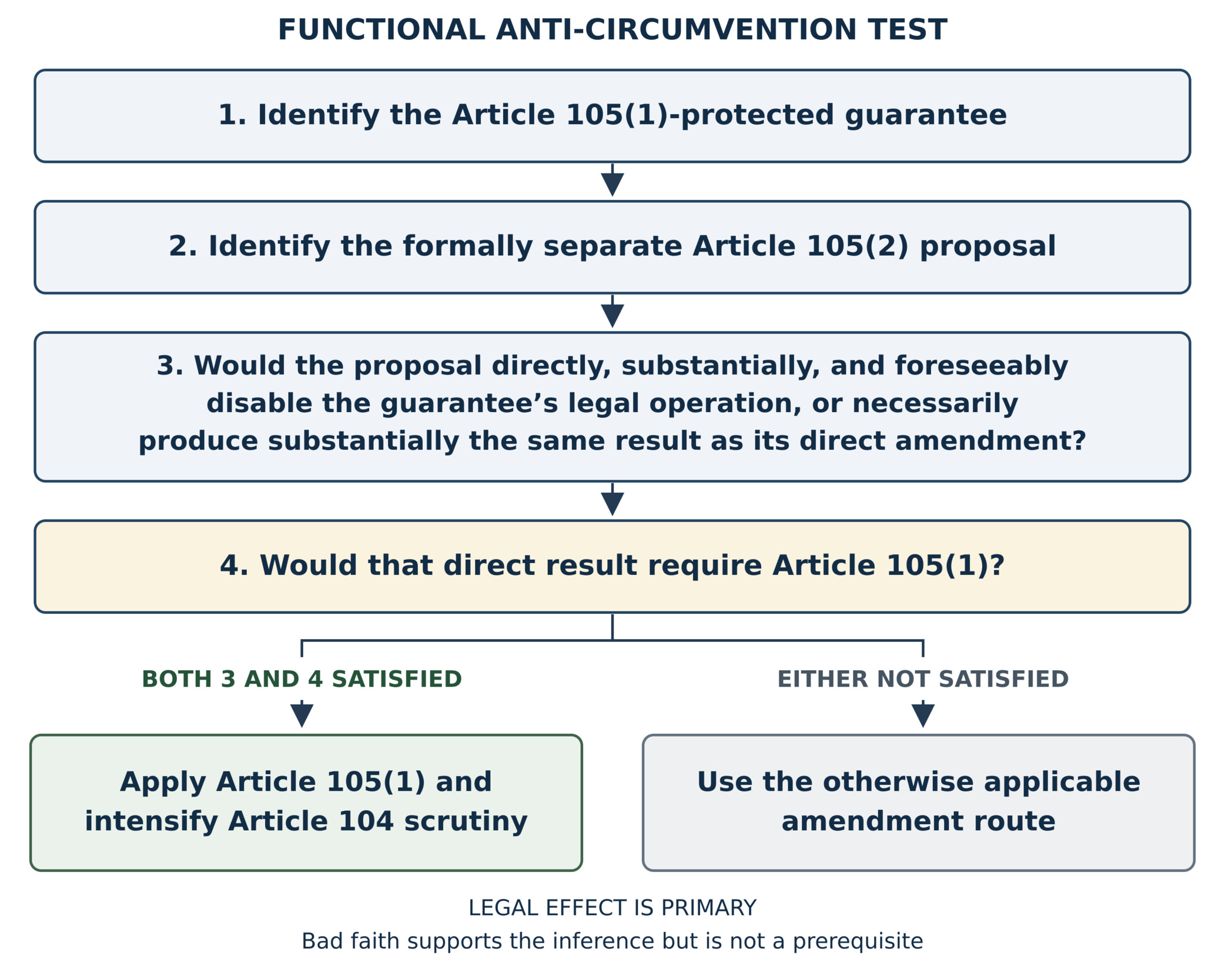
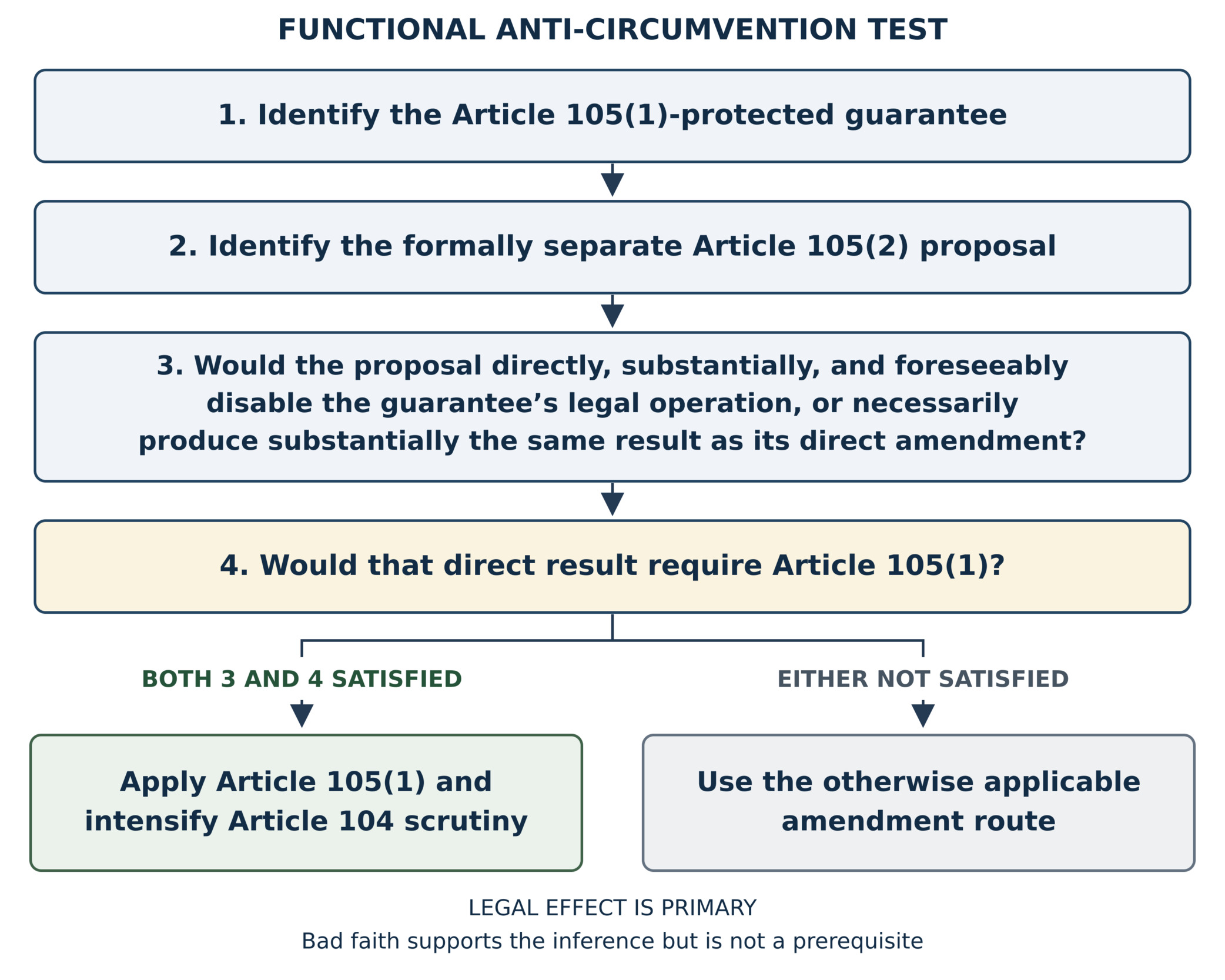
A four-step test makes the proposed interpretation more administrable. The interpreter should: (1) identify the Article 105(1)-protected provision or guarantee; (2) identify the formally separate amendment proposed under Article 105(2); (3) determine whether the latter would directly, substantially, and foreseeably disable the protected guarantee’s legal operation or necessarily produce substantially the same result as its direct amendment; and (4) ask whether that direct result would require Article 105(1). Remote, incidental, speculative, or readily remediable effects are insufficient. If the third and fourth inquiries are satisfied, the proposal should, under the interpretive doctrine defended here, be processed under Article 105(1). Evidence of bad faith, selective timing, or anti-purposive drafting may reinforce the conclusion, but subjective intent is not indispensable; legal effect remains the primary criterion.[2]
Figure 1 summarizes the proposed four-step test; its third and fourth inquiries must both be satisfied.
Institutionally, the CCI would investigate a dispute and recommend an interpretation, while the HoF would make the final decision under Articles 83 and 84. State Councils could invoke the principle when deciding whether a proposal followed the correct track, courts could refer a concrete dispute through constitutional review, and Article 104 deliberations could expose the consequences of formally indirect drafting. Under the proposed doctrine, use of Article 105(2) for a functionally equivalent alteration would mean that the proposal followed the wrong track and should be reconsidered under Article 105(1). This pathway identifies the relevant organs without resolving the independence concerns discussed below.
4.3. Plural constituent power and representation
Federations combine a common political community with territorially organized constituent communities. Aroney et al. (2024) accordingly describe federal constituent authority as plural: a federation is a polity of polities sustained through the tension between unity and plurality. Ethiopia’s Constitution creates a federal polity but speaks in an explicitly plural sovereign voice. State constitutions make constituent authority visible from below, while State-Council participation under Article 105 gives it a role in federal constitutional change (Ararssa 2013).
Amendment institutions exercise constituted rather than original constituent authority (Grimm 2018). In Ethiopia, Article 8’s plural sovereign and Articles 104–105’s participatory and constituent-unit channels require peoples whose status is being redefined to retain an effective authorizing role. Article 8(3) recognizes representative and direct participation; Article 105(1) requires every State Council and both federal houses for protected matters; Article 104 adds the general public and those concerned; and Article 62(4) directs the HoF to consolidate unity on the basis of mutual consent.
The presumption of constituent representation through State-Council approval must distinguish three constitutional categories. Nations, Nationalities, and Peoples are the holders of sovereignty and self-determination under Articles 8 and 39; member States are territorial components of the Federation under Articles 2, 46, and 47; and State Councils are the institutions through which Article 105 formally channels constituent-unit approval. They overlap, but they are not conceptually identical, especially where a State contains several peoples or substantial mobile and urban populations. State Councils are therefore best understood as constitutionally designated institutional proxies for constituent participation: indispensable for amendment validity and presumptively representative, but not conclusive evidence of sociological consent in every circumstance. Broader inquiry becomes relevant only where a replacement-level proposal alters the representative institutions themselves, leaves a territorially concentrated people inadequately represented, encounters coercion or severe party subordination, or follows merely nominal Article 104 participation. Meaningful participation and enforceable rights can address those gaps without displacing State Councils (Abbink 1997; Belina 2026; De Schutter 2021; Van der Beken 2015).
Ethiopian scholarship nevertheless identifies a persistent gap between constitutional form and political practice. Centralized party control has often reduced state institutions to implementers of federal policy (Aalen 2002, 2006; Fiseha 2012), while the Prosperity Party’s creation renewed concerns about recentralization (Aalen 2021).
4.4. Institutional design and reported interpretive practice
The Constitution assigns final interpretation to the HoF, supported by the CCI (FDRE Constitution 1995, arts. 62, 82–84). The current statutory framework is the Council of Constitutional Inquiry Proclamation No. 798/2013 and the House of Federation Proclamation No. 1261/2021, which replaced Proclamations 250/2001 and 251/2001 respectively (Council of Constitutional Inquiry Proclamation 2013; House of Federation Proclamation 2021). The design combines representative guardianship with legal inquiry (Bihonegn 2015; Fiseha 2005; Mulu 2019).
Under Article 61, every Nation, Nationality, and People receives at least one HoF representative; each Nation or Nationality receives an additional representative for each one million of its population. Members are elected by State Councils, which may either elect the representatives themselves or provide for their direct election by the people. This formula gives constituent peoples an institutional presence but does not by itself ensure independent deliberation. Party alignment across federal and state institutions can affect how State Councils select representatives and how the HoF exercises its combined roles in interpretation, self-determination, and amendment. The HoF’s participation in amendment and interpretation therefore creates a risk of self-judgment when party hierarchy links those institutions.
The reported interpretive record is mixed rather than uniformly centralizing. In the Benishangul candidature dispute, the HoF reportedly rejected a requirement that candidates from Amhara, Oromo, and Tigray communities speak one of five local languages while accepting a regional working-language condition; Fiseha (2017) likewise credits the HoF with giving practical effect to identity and local self-government claims, including the Silte process. These examples show that political constitutional interpretation can mediate collective and individual rights rather than simply ratify federal power (Mulu 2019; Fiseha 2017).
Other decisions expose inconsistency in politically sensitive cases. Mulu (2019) finds that the CCI and HoF have not articulated stable interpretive principles and have applied textual, purposive, and harmonious-construction approaches unevenly. In Coalition for Unity and Democracy v. Prime Minister Meles Zenawi, the CCI reportedly upheld restrictions on outdoor assemblies after fact-sensitive review that critics regarded as exceeding its proper role. These materials support a claim of institutional inconsistency and structural vulnerability; they do not establish partisan instruction in every case.
The 2020 election-postponement interpretation illustrates both institutional capacity and risk. The CCI invited 22 amicus curiae submissions and used a holistic, purposive method. Mengie (2021) commends the participatory and interpretive approach but criticizes the open-ended term extension and institutional partiality; Salemot and Dube (2020) argue that constitutional amendment was the preferable route. The case shows that improved procedure does not eliminate concerns about remedial scope or institutional interest.
Table 4 identifies the selected disputes, reported dispositions, and evidentiary bases.
A defensible identity-based anti-circumvention doctrine therefore requires institutional restraint. The HoF should identify the protected guarantee, apply the four-step effect test, and explain how text, structure, history, precedent, alternatives, and cumulative effects justify the chosen amendment track. That inquiry protects every Article 105(1) guarantee without requiring a separate finding of constitutional-identity status. The identity criteria serve the distinct task of assessing the depth of change and its implications for constitutional continuity. The CCI should receive and publish adversarial submissions, and majority and minority reasons should be disclosed. Procedural transparency matters because a doctrine designed to constrain constituted power can itself become an instrument of political entrenchment (Landau 2013, 211–15).
5. Self-Determination and Selected Applications
5.1. The multidimensional content of Article 39
Article 39 extends beyond secession. Its ordinary operation should therefore be understood primarily through internal self-determination: the ability of a people to govern significant aspects of its political, cultural, territorial, and developmental affairs within the federation (Van der Beken 2021). External secession is the final component of a wider structure, not its only meaning.
Regassa likewise treats federalism and self-determination as institutions for managing and transforming conflict rather than eliminating it. On his account, constitutionalizing secession sought to remove the military solution from the political equation and to make continued union compatible with acknowledged political agency—a form of division that can sustain unity. Article 39’s exit guarantee should therefore be read together with its recognition, internal self-government, representation, and shared-rule functions (Regassa 2010).
Meaningful internal self-determination also has material dimensions elsewhere in the Constitution. Article 40 links land and natural resources to the state and the peoples; Article 43 recognizes development rights for each Nation, Nationality, and People; Article 52 assigns states authority over administration, development policy, land, taxation, budgets, civil service, and police; and Articles 94–100 allocate expenditure and revenue powers. A constitutional design that preserves cultural recognition while removing these operational authorities may therefore hollow self-government without formally deleting Article 39.
This distinction matters for amendment. Revising external-secession procedures while preserving the substantive right and robust internal self-government is not equivalent to abolishing territorial autonomy or constituent status. Nor does internal autonomy alone justify abolishing or nullifying Article 39(1)'s external guarantee, which forms part of the stated terms of membership; its removal could amount to dismemberment or replacement. Conversely, formally retaining secession while hollowing self-government through centralized party control, fiscal dependence, or unilateral federal action may erode internal self-determination and intensify exit demands. It does not itself produce secession or dispense with Article 39(4). Reform must therefore be assessed across internal self-rule, shared rule, and the continued substantive availability of external self-determination.
5.2. Internal statehood as constitutional practice
Ethiopian practice demonstrates that self-determination is not merely symbolic. Article 47 has supported demands for internal statehood, most prominently the Sidama referendum and the creation of the Sidama Regional State. Aalen (2021) shows that the claim was long constrained by dominant-party politics and became actionable when political liberalization altered the balance of power. Later referendums through which several zones or special districts collectively formed new regional states have raised further questions about minority consent, referendum design, and territorial reorganization (Afesha 2025). These examples show both the practical force of the right and the danger that a claimant-territory majority can marginalize smaller communities.
The internal-statehood experience supplies two lessons for Article 39 reform. First, internal-statehood procedures illustrate how self-determination claims may be channeled into legal and political processes rather than coercive confrontation when institutions permit those claims to be heard and decided (Belina 2026; Regassa 2010). Second, self-determination must operate together with protections for internal minorities, residents who do not belong to the territorially dominant group, and communities whose boundaries or administrative status may be altered without their consent (Belina 2026; De Schutter 2021; Regassa 2010; Van der Beken 2015, 2021). A legitimate federal bargain is not one in which a national majority is protected from the center while reproducing unreviewable domination within the state.
5.3. External secession and international law
Article 39 is unusual because it creates an express domestic constitutional right to secession. International law is more restrictive. Article 20 of the African Charter recognizes peoples’ right to self-determination (Organization of African Unity 1981), but the African Commission in Congrès du peuple katangais v. Zaire rejected an independence claim in the absence of concrete rights violations and where internal participation remained available (African Commission on Human and Peoples’ Rights 1995). The International Court of Justice’s Kosovo advisory opinion was similarly narrow: it concluded that international law did not prohibit the declaration before it, not that international law establishes a general right of unilateral secession (International Court of Justice 2010).
The Canadian secession reference offers a useful middle position. The Supreme Court of Canada rejected a unilateral constitutional right to secede but held that a clear majority on a clear question would create a reciprocal duty to negotiate. It treated federalism, democracy, constitutionalism and the rule of law, and minority rights as mutually conditioning principles (Reference re Secession of Quebec 1998). Ethiopia differs because Article 39 supplies a domestic legal procedure. Even so, the Canadian insistence that no single principle automatically overrides the others is instructive. Self-determination cannot be analyzed apart from democracy, rights, federalism, and negotiated constitutionalism.
It follows that the dismantling of internal self-determination would not automatically create an international legal right to independence. It could violate the domestic Constitution; undermine the sociological legitimacy of the federal union; increase political support for external self-determination; and strengthen a remedial-secession argument if accompanied by grave and sustained rights violations.
5.4. Pending constitutional processes and the rule against evasion
A related question concerns whether constitutional amendment may be used to defeat a self-determination process already triggered under Article 39(4). The constitutional trigger is specific: a demand must be approved by a two-thirds majority of the legislative council of the Nation, Nationality, or People concerned. The federal government must then organize a referendum within three years under the English text commonly cited. A political statement or party proposal does not by itself establish a legally pending referendum.
Where the constitutional trigger has been satisfied and officially transmitted, a later amendment designed specifically to extinguish the process would raise serious concerns of constitutional evasion, legal certainty, procedural fairness, and good-faith compliance. The strongest claim is not that Ethiopian law already recognizes a freestanding doctrine of estoppel by procedure. It is that constituted institutions should not manipulate amendment rules to defeat a right after the Constitution’s own triggering conditions have been met. Any article applying this principle to a particular petition must produce the legislative resolution, vote, date, receiving institution, and official procedural record. Without that evidence, the matter should be described as a political demand rather than an accrued constitutional right.
5.5. National Dialogue and constitutional reform
The Ethiopian National Dialogue Commission was established by Proclamation No. 1265/2021 to identify fundamental disagreements, organize dialogue, consolidate recommendations, and monitor implementation (Ethiopian National Dialogue Commission Establishment Proclamation 2021). It is not a constitution-amending body. Its work may inform agenda formation and later constitutional proposals, but amendments must proceed under Articles 104 and 105. Official reports on the July 2026 national conference describe roughly 4,000 participants and a multi-stage deliberative process; those figures establish scale, not by themselves representativeness, independence, or participant influence (Ethiopian National Dialogue Commission 2026b, 2026c, 2026d, 2026e).
The Dialogue tests the boundary separating agenda formation and deliberation from constitution-making authority, particularly where disputes concern self-determination, territory, or representation. Table 5 distinguishes six dimensions of this contribution without treating the Commission as a constituent or amendment-making body.
As of July 31, 2026, the constitutive and enabling-condition dimensions remained contested. Independent monitoring and scholarship questioned aspects of neutrality, opposition engagement, inclusion, civic space, and transparency, while Commission accounts emphasized outreach, participant selection, party engagement, and agenda gathering (Center for Advancement of Rights and Democracy 2026; Gelaneh 2026; Kurtz 2024; Liyew 2025; Ethiopian National Dialogue Commission 2026b, 2026c). These assessments concern credibility; the Commission’s recommendations remain preparatory unless adopted through constitutional amendment procedures.
Tigray illustrates the representational problem. The Commission held interim consultations with selected Tigrayan stakeholders in Addis Ababa on April 1–3, 2026, after concluding that conditions did not permit an in-region process. The region subsequently did not participate in the June 1 national election and remained without federal representation. The cited sources leave unresolved whether those consultations can substitute for federal representation, broader in-region participation, and locally credible enabling conditions (Associated Press 2026; Deutsche Welle 2026; Ethiopian National Dialogue Commission 2026a, 2026f).
The constitutional point is limited. The article does not resolve the empirical disputes within the stated assessment period; it uses them to show why agenda gathering, deliberation, and constitutional authorization must remain analytically separate. Substitute participation may sometimes be necessary, but it cannot automatically be equated with direct participation by excluded regions or communities.
5.6. Territorial interdependence and constitutional dispossession
Finfinnee/Addis Ababa and Dire Dawa test whether restructuring can settle contested territorial questions indirectly. Their legal positions differ. Article 49 designates Finfinnee/Addis Ababa as the federal capital, guarantees resident self-government, places its administration under federal responsibility, and protects Oromia’s special interests. Ararssa argues that federal-capital status does not extinguish Oromia’s protected interests, while those interests do not extinguish the individual, municipal, and minority rights of residents (Ararssa 2015, 2016; FDRE Constitution 1995, art. 49).
The Master Plan controversy illustrates why those guarantees must be assessed functionally. The proposed metropolitan plan linked development in Addis Ababa to surrounding Oromia jurisdictions and generated disputes about land administration, boundary authority, displacement, and Article 49(5). Ararssa (2015) argues that such planning can subordinate Oromia’s jurisdiction without formally amending Article 49. The example is illustrative rather than controlling doctrine.
Because Oromia is a named constituent State and a principal territorial expression of Oromo self-government, its abolition or fragmentation would meet the article’s replacement threshold only if it both transformed the constituent identity or constitutional status of the affected people and substantially eliminated, subordinated, or rendered revocable the authority through which that status operates. Limited, consensual, and constitutionally authorized boundary adjustments are different. The dual rights architecture likewise requires reform to preserve both Oromia’s collective and participatory guarantees and the individual, municipal, and internal-minority rights of the city’s residents (Belina 2026).
Dire Dawa’s status derives from Proclamation No. 416/2004, whose preamble acknowledges unresolved claims by Oromia and the Somali Region while its Charter provides resident self-government under federal accountability and requires agreement with neighboring regions for future boundary changes. The arrangement regulates present governance without finally adjudicating territorial status (Dire Dawa Administration Charter Proclamation 2004, preamble, arts. 4, 51).
The resulting principle is territorial non-dispossession: reform claiming constitutional continuity should not resolve a contested city, boundary, or corridor by eliminating or disabling a constituent state, recognized claimant region, or affected community whose participation would otherwise be required. The anti-circumvention inquiry accordingly extends to direct and substantial territorial effects, not only formal wording.
5.7. Eritrea as a historical caution
Resolution 390 A(V) provided for Eritrea to constitute an autonomous unit federated with Ethiopia; the federation became effective in 1952, after which Eritrean autonomy was progressively eroded before the federation was terminated and Eritrea annexed in 1962 (Haile 1987; United Nations General Assembly 1950, 1952). Armed resistance predated termination; the narrower lesson is that destruction of autonomy can intensify an existing independence struggle. The analogy is limited: Eritrea’s arrangement arose through the United Nations under a monarchy, whereas the FDRE regulates self-determination and amendment internally. It is a historical warning about revocable autonomy, not a legal precedent or a claim that centralization mechanically produces secession (Fessha and Dessalegn 2022).
6. Counterarguments and Reform Safeguards
6.1. The instability and exit-incentive objection
The strongest integrationist objection is that territorial federalism and an express secession clause encourage identity mobilization and exit threats. That risk supports stronger trust, rights protection, shared institutions, neutral adjudication, and intergovernmental bargaining; it does not establish that recentralization will resolve conflict (Abbink 1997; Follesdal 2021; Van der Beken 2021).
6.2. The democratic-majority objection
Multinational federations combine population- and unit-based consent because an aggregate majority can permanently redefine a territorially concentrated people’s political status. Articles 104 and 105 respond through public participation, both federal houses, and State Councils. The constituent-legitimacy inquiry is not a legal veto; it asks only whether replacement-level change received renewed plural authorization. The prescribed participatory and constituent-unit channels may satisfy that requirement.
6.3. The internal-minority objection
Protecting constituent nations can subordinate individuals and smaller communities within regional states. Multinational federalism must therefore protect individuals and non-dominant communities, including residents who moved from other regions, urban residents, territorially non-dominant groups, and members of the regional majority who dissent from dominant political positions. Because federalism redistributes public power, rights must constrain regional as well as federal majorities. The dual rights architecture accordingly combines collective self-rule with residence-based participation, non-discrimination, language access, due process, accountable security institutions, and effective remedies (Abbink 1997; Afesha 2025; Belina 2026; De Schutter 2021; Regassa 2010; Van der Beken 2015).
6.4. The rigidity and deadlock objection
Article 105(1)'s all-State-Council rule can create rigidity, but it deliberately protects Chapter Three rights. The absence of an eternity clause is why this article does not treat Article 39 as legally unamendable. Identity doctrine should protect plural political authorship and sustaining rights, not freeze every boundary, institution, or policy (Grimm 2018). Articles 104 and 105 govern reform pursued as amendment; the Constitution creates no separate procedure for an asserted exercise of original constituent power to replace the order.
Constitutional identity can privilege a contested founding settlement over present democratic choice and allow interpreters to select commitments that entrench preferred outcomes. Behrendt and Colón-Ríos (2025) warn that identity protection must remain compatible with democratic transformation; Scholtes (2023) examines its use to advance illiberal goals in the European Union. These are theoretical cautions, not findings about Ethiopia. Here, the risk extends beyond judges to the HoF and political actors who may appropriate collective identity claims. The proposed framework therefore treats identity as a revisable account of constitutional continuity, not a freestanding veto. Amendment-track selection requires demonstrated effects on a textually protected guarantee, and foundational change remains possible through Articles 104–105. Renewed plural authorization addresses constituent legitimacy without adding a rule of formal invalidity. Published reasons, adversarial submissions, and protection of internal minorities constrain selective interpretation, but cannot eliminate discretion or partisan capture.
6.5. The enforceability objection
Enforceability remains serious because the HoF controls constitutional interpretation. The framework therefore disciplines constitutional classification, institutional reasoning, and public justification even where existing review cannot guarantee judicial independence.
6.6. Requirements for legitimate reform
The framework permits amendment of Article 39 and redesign of the federal system, subject to four linked requirements.
1. Identify and classify the change. The textually protected provision or guarantee and, for formally indirect proposals, the anti-circumvention test determine the amendment track under the interpretation defended here. The identity criteria assess the depth of change; the two-condition replacement threshold identifies displacement of the multinational settlement. Renewed plural authorization then concerns the continuing constituent legitimacy of replacement-level change. These inquiries are related, but identity status is not a prerequisite for Article 105(1) protection.
2. Comply with constitutional procedure and protect existing processes. Articles 104 and 105 exhaust the amendment-specific positive-law procedures. A validly approved and officially transmitted Article 39(4) demand should not be defeated by a later amendment, and any claim of a pending right requires the official record. The CCI and HoF should publish reasons, evidence, recommendations, conflicts, minority opinions, and responses to competing submissions.
3. Secure democratic and constituent participation. State-Council approval is indispensable and presumptively representative. Affected peoples, opposition actors, civil society, women, youth, displaced communities, and internal minorities should be able to influence agendas, evidence, alternatives, and text. Supplemental mechanisms may reinforce, but cannot displace, Articles 104 and 105.
4. Protect rights through a dual rights architecture. Reform should preserve existing constitutional guarantees and, where documented deficiencies arise in implementation, strengthen the institutions and remedies that make them effective. The point is not that every listed guarantee is presently absent. It is that reform should evaluate collective self-rule, language, culture, land protection, and self-determination together with individual equality, internal-minority protection, due process, mobility, civic freedoms, residence-based participation, accountable security institutions, and effective remedies (Belina 2026).
7. Conclusion
Article 39 is formally amendable under Article 105(1), but it is the principal operative guarantee of Ethiopia’s clustered multinational constitutional identity. That identity also rests on plural sovereignty, territorial statehood, divided material authority, representation, and differentiated amendment. A proposal that directly, substantially, and foreseeably disables an Article 105(1)-protected guarantee should, under the effect-based interpretation defended here, be treated as requiring Article 105(1), whatever provision it formally targets.
Amendment, dismemberment, and replacement are analytical classifications, not additional Ethiopian procedures. Articles 104 and 105 govern legal amendment. Meaningful public participation and independently deliberated approvals under those provisions may supply renewed plural authorization for replacement-level change; a process that bypasses them cannot derive legal validity from the 1995 Constitution. Claims about reform should therefore identify whether they concern formal legality, substantive continuity, procedural legitimacy, constituent legitimacy, or sociological durability.
Special entrenchment would lose its function if Article 39’s protected operation could be disabled through formally easier amendments elsewhere. For Ethiopia’s multinational settlement, the replacement threshold nevertheless requires both a transformation of the identity or constitutional status of the constituent subjects and substantial elimination, subordination, or revocability of the authority through which that status operates. Altered institutions, boundaries, or membership terms alone do not establish replacement. The aim is to keep constitutional reform possible while protecting the plural political authorship on which the federation rests.
Tsegaye Regassa and Tsegaye R. Ararssa refer to the same scholar. The references retain the name used in each publication.
These are hypothetical applications of the proposed doctrine, not reported holdings. An amendment to Articles 50 and 52 that leaves Article 39 unchanged but abolishes autonomous regional legislative and executive authority, replacing it with powers revocably delegated by the federal executive, would disable Article 39(3)'s self-government guarantee. Because the equivalent direct alteration of that guarantee requires Article 105(1), the proposal should follow that track under the interpretation defended here. By contrast, an Article 52 amendment permitting neighboring States voluntarily to administer a specified service jointly, while retaining their governing institutions, meaningful autonomous authority, and ability to withdraw, would not on those assumptions disable the guarantee or necessarily produce its substantive amendment. Article 105(2) would remain applicable. “Directly” concerns the causal connection to the legal effect, not direct textual amendment (FDRE Constitution 1995, arts. 39(3), 50, 52, 105).